1. Overview of Two Coarse Filtration Equipment
For raw water, circulating water and process fluid pretreatment, the high flow filter cartridge and matched water filter housing undertake fine polishing tasks, while upstream coarse filtration relies heavily on self-cleaning filters or basket strainers to intercept large particles, sediment and flocs. Choosing the wrong coarse filter will cause frequent clogging of downstream fine filter elements, raise consumable costs and disrupt stable production. Although both are designed to remove large solid contaminants from liquid pipelines, their working modes and operation logic are completely different. Basket strainers belong to passive filtration equipment that requires offline manual cleaning, while self-cleaning filters realize online automatic flushing or brushing without stopping the main pipeline flow.
2. Core Structural & Working Principle Comparison
2.1 Basket Strainer
A basket strainer consists of a flange body, a removable perforated or mesh filter basket, a quick-open cover and drain ports. Fluid flows into the strainer, solid impurities are trapped inside the basket, and clear liquid flows out.
When the basket accumulates too much dirt, the pressure difference rises. Operators need to shut down the valve, release internal pressure, open the cover, take out the basket, wash it with water or brush, then reinstall it to resume operation.
Common filtration precision: 200 μm ~ 5 mm.

2.2 Self-cleaning Filter
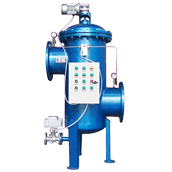
The self-cleaning filter is equipped with internal brush/scraper assembly, suction scanner, drive motor, automatic drain valve and differential pressure controller. Liquid passes through the cylindrical filter screen from inside out or outside in.
Once the preset differential pressure or timer trigger condition is reached, the cleaning cycle starts automatically. The brush or suction nozzle moves along the screen surface to strip contaminants, and the dirt is discharged through the blowdown valve, all while the main pipeline keeps running without flow interruption.
Common filtration precision: 50 μm ~ 2 mm.

3. Advantages and Limitations
3.1 Basket Strainer
Advantages
Low initial procurement cost, simple structure with few vulnerable parts.
Easy inspection; the filter basket can be quickly taken out for visual check of impurity type.
Small footprint for small flow pipelines, convenient for temporary bypass and backup use.
Wide material options: 304/316L stainless steel, duplex steel can be customized for corrosive fluid.
Limitations
Cleaning requires pipeline shutdown, not suitable for 24-hour uninterrupted production lines.
Heavy labor workload for frequent dirt-heavy working conditions.
Not friendly for high flow applications; multiple units in parallel increase pipeline complexity.
Mesh basket is easy to deform under high differential pressure if blocked severely.
3.2 Self-cleaning Filter
Advantages
Online automatic cleaning, no need to stop the main flow, ideal for continuous industrial production.
Suitable for large flow and high suspended solids medium such as salt lake raw brine, power plant cooling water.
Differential pressure automatic control reduces manual monitoring work.
Stable long-term operation, greatly reduces the frequency of opening the vessel.
Limitations
Higher upfront investment cost than basket strainer.
Contains electrical and moving components, needs regular maintenance for motor, seal and brush.
Not suitable for extremely sticky, fibrous impurities which may wind around the brush assembly.
Repair work needs professional technicians compared with simple basket replacement.
4. Key Selection Factors
4.1 Production continuity requirement
If the system cannot tolerate shutdown, such as salt lake brine delivery lines, data center cooling water, membrane feed water pretreatment: choose self-cleaning filter.
For intermittent working systems, small-batch test lines, auxiliary pipelines that can be shut down for maintenance: basket strainer is cost-effective.
4.2 Flow rate and impurity load
Large flow + high suspended solids, continuous feed: self-cleaning filter.
Small flow, low impurity content, low clogging frequency: basket strainer.
4.3 Fluid characteristics
Hard granular sediment, sand, sludge: both are available; self-cleaning brush type performs better.
Long fiber, sticky sludge: basket strainer is easier to clean manually, self-cleaning brush may get tangled.
Corrosive medium such as high-chloride brine: both can use corrosion-resistant materials, but pay attention to the shaft seal of self-cleaning models.
4.4 Budget and labor allocation
Limited budget, enough on-site maintenance workers: basket strainer.
Long-term operation, labor shortage, priority to reduce downtime: self-cleaning filter.
4.5 Matching with downstream fine filtration
No matter which coarse filter you select, it usually serves as the protection for downstream water filter housing and high flow filter cartridge. A properly sized upstream coarse filter can block most large grit, extend the service cycle of fine cartridges and lower the overall operating cost.
5. Typical Application Scenario Recommendation
Choose Self-cleaning Filter
Raw brine intake for salt lake lithium extraction
Data center prefabricated cold source circulating water
Seawater desalination raw water pretreatment
Power plant circulating cooling water
Large chemical continuous process water
Choose Basket Strainer
Small pump inlet protection
Bypass pipeline, sampling pipeline
Small batch pilot test equipment
Back-up safety filtration for fine filter housing
Low-flow domestic water and auxiliary equipment pipelines
Combined Configuration Suggestion
Many large projects adopt a combined scheme: self-cleaning filter as main coarse filtration + basket strainer installed on bypass as emergency backup, then followed by multi-cartridge water filter housing equipped with high flow filter cartridge for polishing filtration. This setup balances continuity, safety and cost.
6. Conclusion
There is no absolute better product between self-cleaning filter and basket strainer. The core of selection is matching the equipment with production continuity, flow rate, impurity property and on-site maintenance condition. Basket strainer is a simple, economical passive filter for discontinuous and small-flow conditions. Self-cleaning filter is an automated solution oriented to large-scale, uninterrupted industrial production. LEFILTER supplies both types of filters, together with supporting water filter housing and high flow filter cartridge. Our engineering team can calculate parameters and provide a complete staged filtration scheme according to your P&ID and working condition sheet.
FAQ
Q1: Which one has finer filtration precision?
A: Basket strainers can achieve finer precision down to 200μm and below, while conventional self-cleaning filters are mostly above 50μm. Special customized self-cleaning types can reach 20μm, but the cost rises obviously.
Q2: Can a basket strainer run continuously without stopping?
A: Normally no. Unless you install two basket strainers in parallel with switching valves, one online and one offline for cleaning.
Q3: Will self-cleaning filter consume much water during backwashing?
A: The blowdown volume is far less than the liquid flow of the main pipeline. Suction-scan self-cleaning types have lower blowdown consumption than brush versions.
Q4: Can self-cleaning filter replace basket strainer completely?
A: Not recommended. Basket strainers are still irreplaceable for small pipelines, sampling points and emergency backup due to low cost and simple structure.
Q5: What is the common material for filter screen/basket?
A: 316L stainless steel is the mainstream. Duplex stainless steel is selected for high chloride brine and strong corrosive fluid.
Recommended Related Articles
Difference Between High Negative Pressure Dust Collector and Standard Dust Collector
Application of Automated Dry Ice Blasting Technology in Lithium‑Ion Battery Manufacturing
Application of Self-Cleaning Filters in Aluminum Die-Casting Circulating Cooling Water
Middle and Senior Management Training: "The Wisdom of a Team - Heart Method" in Zhengzhou
Suspended particulate matter removal shallow sand filter