High negative pressure dust collectors and standard dust collectors play different roles in industrial dust control.
In short, high-negative-pressure systems feature high suction, low air volume, and excel at deep cleaning at specific points. Standard dust collectors are characterized by large air volume, low negative pressure, suitable for overall dust removal in a space. Their core differences are shown below:

01 Core Power
High Negative Pressure Dust Collector: Uses multi-stage centrifugal fans, vortex fans or Roots blowers. Vacuum degree is normally above 10–50kPa, up to 100kPa.
Standard Dust Collector: Mostly uses low/medium-pressure centrifugal fans. Wind pressure ranges 1–10kPa.
02 Air Volume & Pipe Diameter
High Negative Pressure Dust Collector: Only 125–250 m³/h per station (about 1/6 of standard). Small diameter (e.g., DN50), high wind speed (≈35 m/s) to avoid dust settlement.
Standard Dust Collector: Large air volume, 800–1500 m³/h per station. Large pipe diameter requires sufficient speed to keep dust suspended.
03 Structure & Material
High Negative Pressure Dust Collector: High structural strength. 4–8mm steel plate with reinforcing ribs and full welding to avoid collapse or leakage.
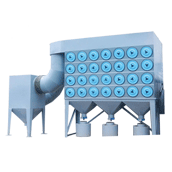
Standard Dust Collector: Lower strength requirements, mostly cabinet-type, flexibly expandable filter area.
04 Working Principle
High Negative Pressure Dust Collector: Extremely strong suction. Rapidly draws dust into a closed system via long pipelines (up to 200m) and collects directly at the source.
Standard Dust Collector: Uses large air volume for overall ventilation. Guides dusty air into the unit through a hood like a large exhaust fan.
05 Capture Efficiency
High Negative Pressure Dust Collector: Very strong suction. Captures fine particles above 0.3μm and heavy particles, efficiency >99%.
Standard Dust Collector: Weak capture for ultrafine particles (<1μm). Simple mechanical types only effective for coarse particles >10μm.
06 Typical Applications
High Negative Pressure Dust Collector: Heavy-duty, complex conditions such as steel plants, power plants, workshop cleaning, belt blanking; high-precision industries like aerospace and electronics.
Standard Dust Collector: Small, scattered dust points such as welding stations, woodworking shops, small crushing stations.
07 Cost & Maintenance
High Negative Pressure Dust Collector: Higher initial investment, but lower energy use (30–35% energy saving) and low failure rate; lower life-cycle cost.
Standard Dust Collector: Lower initial cost, but higher energy and maintenance costs (e.g., filter bag replacement); higher long-term operating cost.

How to Choose the Right Dust Removal System?
1 Analyze Dust & Process Properties
Particle size/weight: Fine (<1μm) or heavy dust → prefer high-negative-pressure systems.
Temperature/humidity: High-temperature flue gas needs heat-resistant filters; water-agglomerating dust is not suitable for standard baghouses.
Explosiveness: Aluminum/coal powder requires anti-static filters, explosion vents, and grounding.
Concentration/viscosity: High concentration needs larger filter area or pre-dedusting; high-viscosity dust needs proper cleaning methods.
2 Calculate Key Parameters
Air volume: Based on dust points and hood type.
System negative pressure: Based on pipe length, diameter, elbows. Longer pipes need higher negative pressure.
Filter area: Based on air volume and filter velocity (<1.2m/min for high negative pressure).
3 Match Core Components
Fan: Choose high-negative-pressure low-volume fan or large-volume low-pressure fan based on system needs.
Filter unit: Use multi-stage filtration (cyclone + filter cartridge + HEPA) for low emissions; PTFE membrane for high-temperature or sticky dust.
4 Evaluate Economy & Safety
Conduct life-cycle cost analysis and comply with national explosion-proof and emission standards.