Application of Automated Dry Ice Blasting Technology in Lithium‑Ion Battery Manufacturing
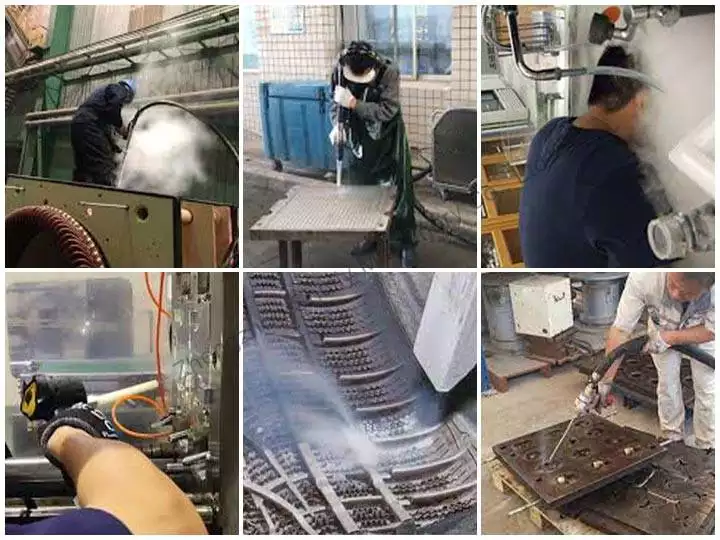
Automated dry ice blasting uses solid CO₂ particles at −78.5°C as the medium. Combining low‑temperature embrittlement, high‑speed impact, and instantaneous sublimation micro‑explosion with robotics, automatic nozzles, and online closed‑loop control, it achieves water‑free, chemical‑residue‑free, precision non‑destructive, and in‑line non‑stop automated cleaning across the entire lithium‑ion battery production process. It fully meets stringent requirements for high cleanliness, moisture resistance, short‑circuit prevention, and high precision, covering electrode manufacturing, cell assembly, electrolyte filling and encapsulation, module PACK, equipment maintenance, and recycling & disassembly. It resolves core pain points of traditional methods such as residues, short circuits, low efficiency, and substrate damage.
I. Technical Principle and Automated System Composition
1. Core Cleaning Principle
Dry ice particles are accelerated by compressed air and sprayed onto the workpiece surface in three steps:
Kinetic Impact: High‑speed particles physically impact and strip surface dust and debris.
Low‑Temperature Embrittlement: Ultra‑low temperature rapidly embrittles oil, paste, adhesive layers, and oxide layers, greatly reducing adhesion.
Sublimation Micro‑Explosion: Dry ice instantly sublimes into CO₂ gas, expanding nearly 800 times in volume to thoroughly remove contaminants in gaps with no solid residue, moisture, or waste liquid.
2. Automated System Components
The integrated line solution includes a dry ice supply system, intelligent blasting host, multi‑axis robotic arm / linear rail nozzles, visual positioning, closed‑loop parameter control, dust extraction, ice blockage detection, and safety interlocks. It can connect directly to the lithium‑ion MES system for unmanned operation, traceable parameters, and consistent cleaning quality.
Flexible precision nozzles (0.3–3 mm adjustable) reach tabs, gaps, die slots, and tiny cell clearances.
Stepless pressure regulation (0.1–0.8 MPa), adaptive particle size, and pulsed intermittent blasting.
Visual recognition and positioning, automatic path planning, real‑time ice feed monitoring, and automatic warning and shutdown for ice blockage.
II. Application Scenarios in the Full Lithium‑Ion Battery Production Process
1. Electrode Manufacturing (Coating / Calendering / Slitting / Tab Making)
Coating Process: Cleans coating die slots, lips, rolls, and back rolls. Removes dried cathode/anode paste and powder residues. In‑line non‑stop cleaning during material changes restores die precision and reduces coating defects. Downtime reduced from hours to 10–30 minutes.
Slitting / Tab Making: Cleans slitting tools, electrode edges, and tab roots. Removes burrs, copper/aluminum foil debris, and dust. In‑line follow‑up cleaning prevents internal micro‑short circuits and self‑discharge.
Tab Pretreatment: Precisely cleans oxide layers, oil, and dust to improve welding conductivity and bonding strength, reducing cold joints.
2. Cell Assembly, Electrolyte Filling & Encapsulation (Winding / Lamination / Welding / Filling)
Winding / Lamination: Cleans winding pins, lamination platforms, separator edges, and bare cell surfaces. Low‑temperature, low‑pressure cleaning protects 6‑μm ultra‑thin separators and coatings with zero moisture.
Tab Welding: Cleans welding interfaces, busbars, terminals, and surrounding areas. Removes scale, spatter, flux residues, and oil to improve weld strength and conductivity.
Filling & Sealing: Cleans filling holes, aluminum cases/pouch aluminum‑plastic film sealing surfaces, and seal grooves. Completely dry cleaning avoids electrolyte hydrolysis and seal failure, suitable for explosion‑proof filling workshops.
3. Module & PACK Assembly
Cleans cell terminals and busbars to optimize high‑current welding and reduce module resistance and heat.
Cleans PACK housings, cooling systems, and structural parts; long nozzles reach internal pipelines to improve heat dissipation and sealing reliability.
Non‑destructively cleans BMS PCBA to remove flux, solder dust, and particles, enhancing insulation and circuit stability.
4. In‑Line Maintenance of Full‑Line Production Equipment
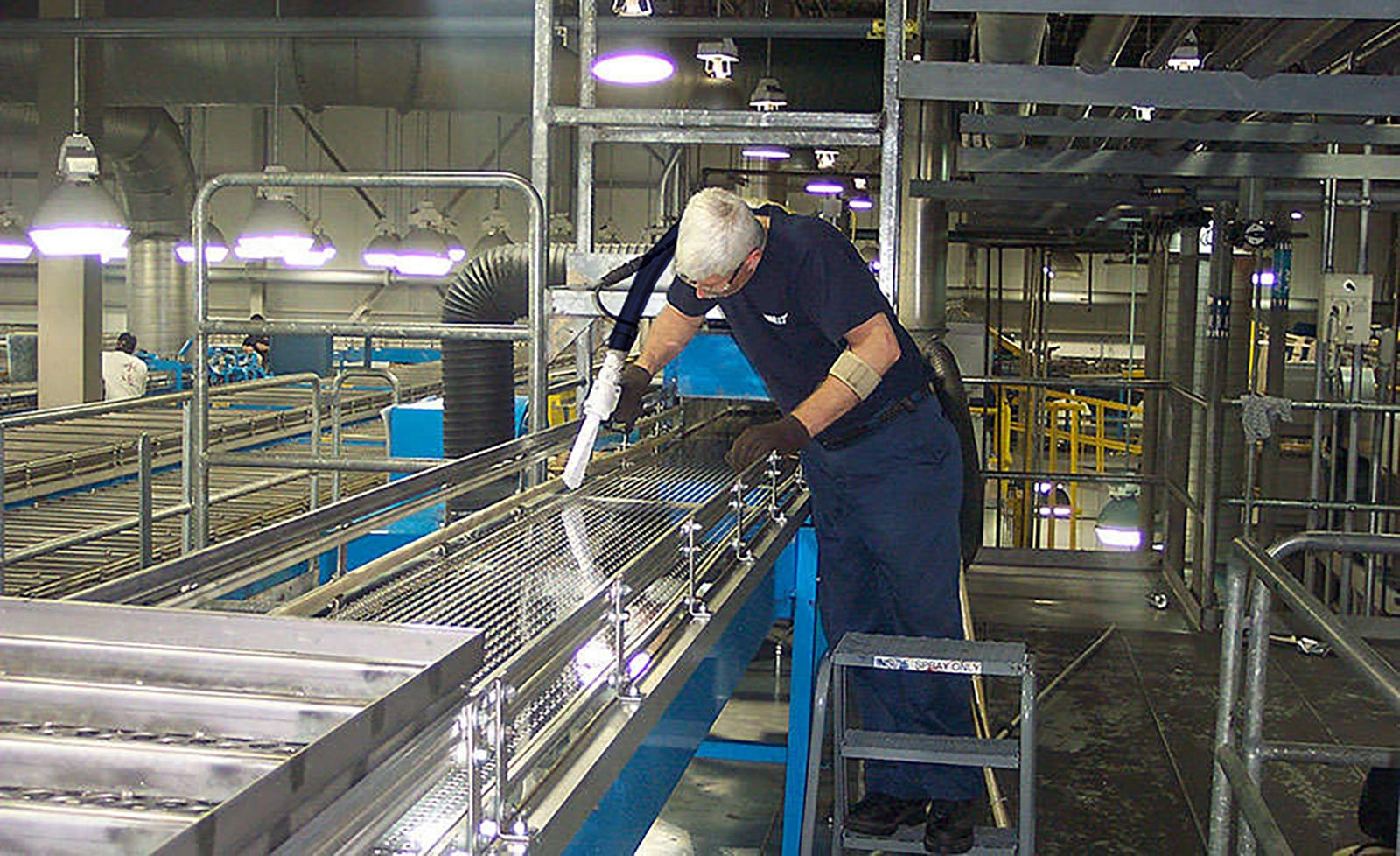
In‑line automated cleaning without disassembly for coaters, slitters, winders, welders, and calenders. Removes paste buildup, dust, oil, and adhesive deposits, greatly shortening downtime and improving OEE. Field data shows maintenance time reduced from 6 hours to 30 minutes, OEE increased from 65% to 87%, with annual scrap losses cut by over ¥2 million.
5. Lithium‑Ion Battery Recycling & Disassembly
Automatically strips oxide layers, rust, electrolyte residues, and blue film/adhesive residues from retired cells, module housings, and metal tabs. Non‑destructive pretreatment protects current collectors and improves material recovery purity for echelon use and material regeneration.