Introduction to Automatic Backwash Filters
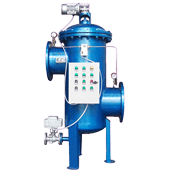
The automatic backwash filter (self-cleaning filter) is a precision solid-liquid separation device that automatically completes filtration, cleaning, and blowdown without shutdown or disassembly. It is mainly used to remove suspended solids, particles, sediment, rust, bio-slime, and other impurities from fluids, reduce turbidity, and protect downstream equipment.

Basic Structure
Main body: Carbon steel or stainless steel cylinder
Core filter element: Stainless steel wedge wire, woven mesh, or sintered mesh (precision: 5–2000μm)
Cleaning mechanism: Backwash rotating arm, suction nozzle, brushing device, motor, reducer
Control unit: PLC, differential pressure transmitter, timer/manual control, drain valve

Working Principle
Raw water enters through the inlet and passes through the filter element, which traps impurities; clean water flows out from the outlet.When the filter screen becomes clogged, the inlet-outlet pressure difference reaches the set value, or the timer cycle expires, the system automatically initiates backwashing.The backwashing mechanism (rotating arm, suction nozzle, or brush) cleans the screen one by one, using the system’s own water pressure for reverse flushing. Contaminants are discharged through the drain valve.The cleaning process takes only tens of seconds, with uninterrupted water supply and no impact on production.

Core Features of Automatic Backwash Filters
Continuous operation, no shutdownUninterrupted water supply during backwashing, eliminating production downtime caused by traditional filter cleaning.
High automation, labor-freeTriple control (differential pressure, timer, manual) automatically detects fouling and triggers cleaning, enabling long-term unattended operation.
High filtration precision, large dirt-holding capacityOptional precision from 5–2000μm; wedge wire and sintered mesh feature high strength and strong dirt-holding capacity.
Water and energy savingBackwash water consumption is only 1%–3% of treatment capacity; uses system pressure without additional power.
Corrosion resistance, long service lifeFilter elements and housing are mostly 304/316L stainless steel, suitable for neutral, weakly corrosive, high-temperature, and high-pressure conditions.
Low maintenance costNo consumables, few wearing parts, long screen life, significantly reducing labor and downtime maintenance costs.

Application in Aluminum Die-Casting Circulating Cooling Water Systems
Circulating water in aluminum die-casting workshops contains aluminum powder, residual release agent, sediment, rust, and bio-slime, which easily clog heat exchangers, cooling towers, and nozzles, reducing heat exchange efficiency, increasing energy consumption, and corroding equipment.
Self-cleaning filters deliver the following key values:
Stabilize water quality, remove impurities at the sourceAccurately trap aluminum powder, release agent residue, sediment, rust, and suspended solids to reduce turbidity.Reduce bio-slime growth and slow pipeline and equipment corrosion.
Protect core equipment, extend service lifePrevent clogging of die-casting machine coolers, mold cooling channels, cooling tower fillers, and nozzles.Reduce wear and corrosion of pumps, valves, and pipelines, and extend equipment overhaul cycles.
Improve heat exchange efficiency, significant energy savingPrevent scaling on heat exchange tube walls, maintain high heat transfer coefficient, and reduce cooling energy consumption by 15%–30%.Stabilize mold temperature, improve casting quality and yield, and reduce reject rates.
Ensure continuous production, reduce downtimeAutomatic backwash without shutdown, avoiding production line downtime due to filter clogging.Greatly reduce manual disassembly, cleaning, unclogging, and water replacement frequency, lowering maintenance labor and time costs.
Save water and reduce emissions, lower operating costsImproved circulating water cleanliness extends replacement cycles and reduces makeup water volume.Reduce chemical dosing and lower comprehensive water treatment costs.