1. Definition
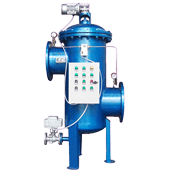
A self-cleaning filter is an intelligent filtration device based on the principle of filter screen interception. It utilizes a built-in cleaning mechanism (such as a suction brush head, scraper, backwash nozzle, etc.) to automatically identify impurity buildup, automatically clean the filter screen, and automatically discharge contaminants. It eliminates the need for manual filter screen disassembly and cleaning, and can complete self-cleaning without interrupting water/liquid supply. It is widely used in water systems and industrial fluid systems for impurity filtration. Its core function is to remove solid particles, suspended solids, and other contaminants from the medium, protecting the safe operation of downstream equipment.
2. Core Working Principle
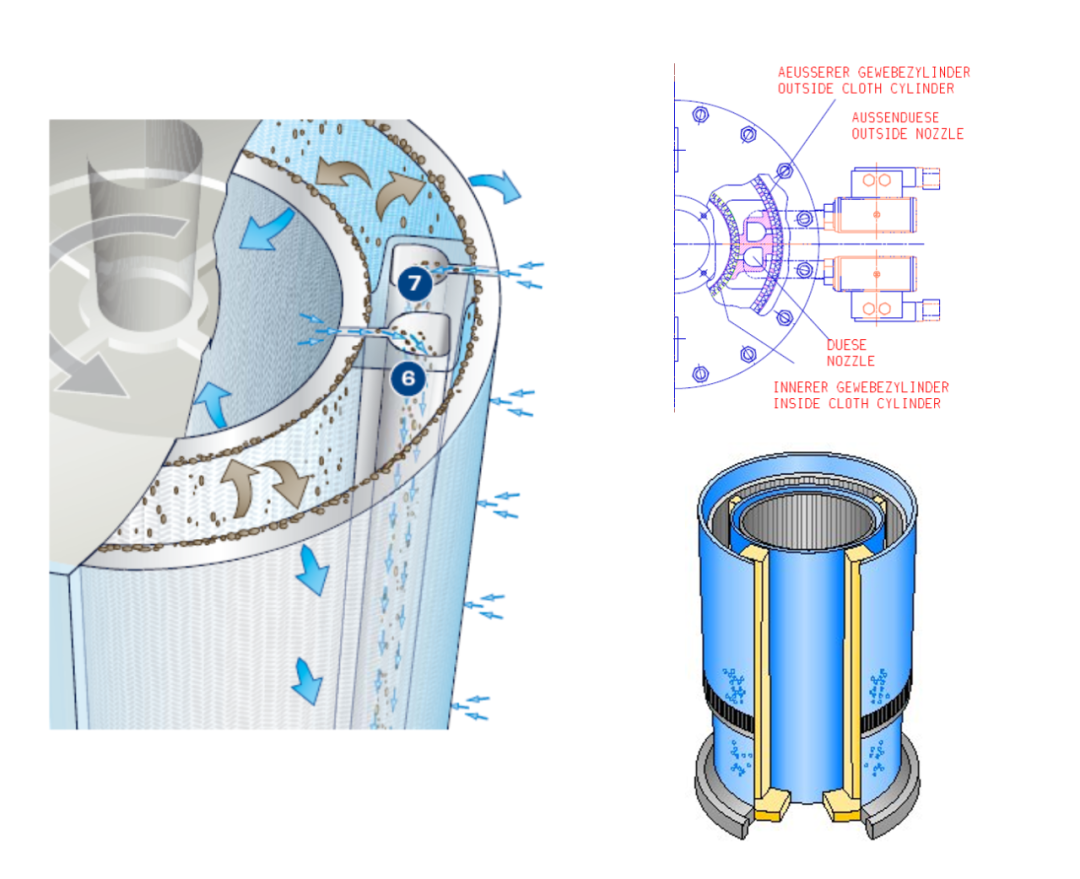
The self-cleaning filter's workflow can be divided into four key stages, forming a closed-loop operation:
① Filtration Stage: Raw water/fluid enters the filter through the inlet. As it flows through the filter screen, solid impurities are intercepted on the surface (or inside) of the screen. The filtered clean medium flows out through the screen gaps from the outlet, supplying the downstream system.
② Cleaning Trigger: When impurities accumulate to a certain extent on the filter screen surface, the pressure difference across the screen increases (detected by a differential pressure transmitter), or the preset cleaning time is reached (controlled by a time relay). The control system automatically triggers the cleaning program.
③ Self-Cleaning Stage: The cleaning mechanism starts (e.g., a suction pump drives a rotating brush head to scrape the filter screen, a backwash valve switches the flow direction to form reverse flushing, and a scraper slides along the filter screen surface), peeling off contaminants from the filter screen surface. Simultaneously, the drain valve opens, forming a localized high-speed discharge flow.
④ Discharge and Recovery: The peeled contaminants are discharged from the drain outlet with the discharge flow. After the cleaning process lasts from a few seconds to tens of seconds, the pressure difference across the filter screen returns to normal, the cleaning mechanism stops working, the drain valve closes, and the filter returns to normal filtration status.
2. Core Features of Self-Cleaning Filters
① High degree of automation, no manual intervention required
The entire process, from "impurity detection - cleaning start - sewage discharge - reset," is automatically completed by the control system (PLC + sensors), eliminating the need for manual filter disassembly and cleaning, thus reducing the workload of maintenance personnel.
The differential pressure threshold (e.g., 0.05-0.1MPa) and cleaning cycle can be adjusted according to actual water quality conditions to adapt to different operating requirements.
② Continuous operation, no downtime risk
Adopting an "online cleaning" design, the filter does not need to be shut down or the fluid supply cut off during the cleaning process (some models achieve this through bypass pipelines and partitioned filter design), avoiding system interruptions caused by the "shutdown and disassembly" required by traditional manual filters, making it particularly suitable for uninterrupted fluid systems.
③ Adjustable filtration accuracy, wide adaptability: The filter screen accuracy range covers 5-3000μm, selectable according to downstream equipment requirements (e.g., 5-50μm for precision units, 100-500μm for pipeline protection); Filter screen materials include stainless steel (304, 316L), wedge mesh, sintered mesh, etc., offering strong corrosion resistance and wear resistance, suitable for various media (clean water, water containing small amounts of oil, weak acid and alkali fluids, etc.).
④ Low maintenance cost and long service life: No consumable replacement is required (the filter screen can be repeatedly washed and reused). Only periodic inspection and cleaning of the mechanism and seals are needed, resulting in significantly lower maintenance costs compared to disposable filters or manually cleaned filters; The filter screen is made of high-strength material, with strong anti-clogging and impact resistance, and a service life of 5-8 years under normal operating conditions.
⑤ Energy-saving and environmentally friendly, low water/energy consumption: The backwashing/cleaning process consumes very little water, only 0.5%-1% of the total flow (some models can be as low as 0.1%), far lower than the water consumption of traditional filter "disassembly and washing". The cleaning mechanism has low power (usually tens to hundreds of watts), low energy consumption, and avoids the additional energy consumption of manual cleaning (such as disassembling and cleaning equipment, transporting wastewater, etc.).
⑥ Strong dirt resistance and adaptability to complex water quality: The filter screen structure is reasonably designed (such as the "loose outside and tight inside" structure of the wedge screen), making it less prone to clogging and capable of treating fluids with high suspended solids concentrations (such as sandy water and industrial circulating water). Some models support high temperature (≤120℃) and high pressure (≤4.0MPa) conditions, suitable for the harsh operating environments of pumped storage, thermal power, and other industries. ⑦ Compact structure and easy installation
Integrated design, small size and light weight, occupying only 1/3 to 1/2 of the area of traditional filters; Supports vertical and horizontal installation, can be directly connected to existing pipelines without complicated modifications, suitable for scenarios with limited computer room space.