High Flow Filter Cartridge for Brewery and Beverage Process Water
Introduction:Beer is about ninety per cent water, and a soft drink rather more. That single fact governs every decision about process water in a brewery or a beverage plant: the water is not an ingredient that happens to be used in large amounts, it is the product's body, its mouthfeel and, when something goes wrong, its defect. Two failure modes dominate. The first is particulate — carbon fines from a decolourising or dechlorinating adsorber, filter aid, sediment from a mains interruption — which reaches the filler as visible haze or as a speck in a bottle that a customer photographs. The second is sensory, and it is more subtle: chlorine and chloramine react with the phenols in malt and fruit to form chlorophenols, which are detectable at parts per billion and are read by a drinker as "medicinal" or "stale". A filtration stage in this duty must therefore be built to food‑contact standards, must not shed a single fibre into the product stream, must survive hot caustic cleaning, and must be honest about where its capability ends — a depth cartridge is not a sterile boundary. This article covers a high flow cartridge for brewery and beverage process water, including construction, capture behaviour, typical specifications, advantages in this duty, application points, compatibility notes, selection criteria and the cleaning discipline that keeps a food filter from becoming a microbiological risk.
We're here to help:
Easy ways to get the answers you need.
Product parameter:
Product Introduction
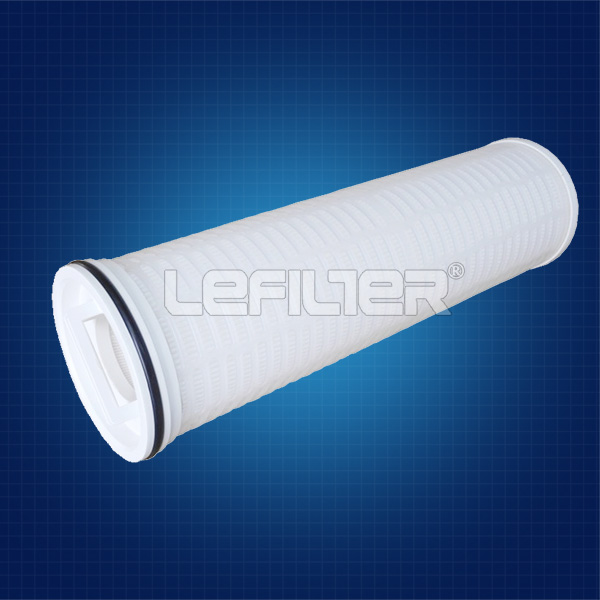
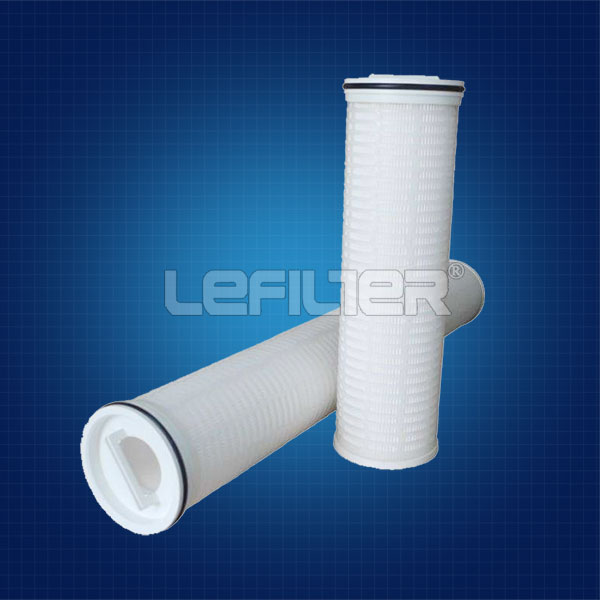
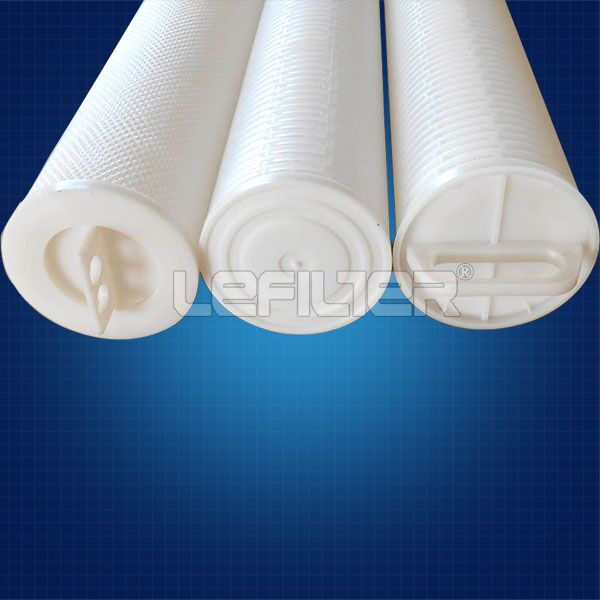
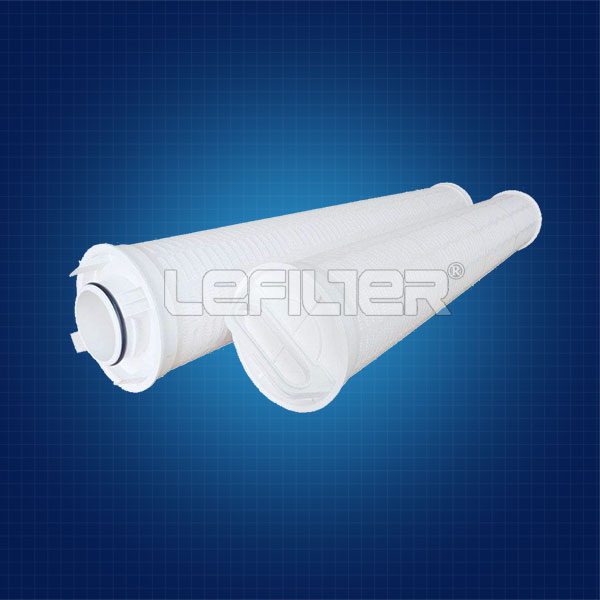
This high flow filter cartridge is a 6 in × 40 in single‑open‑end element for the polishing positions in a beverage water train: downstream of a carbon adsorber, ahead of a reverse osmosis stage, and on the final rinse of a cleaning‑in‑place circuit. Its construction is deliberately conservative — binder‑free glass or PVDF media, no metal in the flow path, a sealed cage, and no silicone or lubricant anywhere near a seal — because the failure that matters here is not a loss of efficiency but a single fibre or a smear of grease in a product that is sold to the public. One element passes 150–350 gpm (34–80 m³/h), so a water filter housing of two elements serves a filler hall's process water without a cartridge bank, and where the plant draws on a municipal supply with a variable sediment load a self‑cleaning filter upstream takes the coarse fraction and protects the fine element from events that are not the plant's fault. The element is a compatible‑format replacement for large‑format high‑flow envelopes; it is not an original equipment part and carries no manufacturer endorsement.
Working Principle
Water enters the housing and passes from the outside of the pleat pack inward, so retained solids stay on the upstream face and clean water reaches the core, the outlet and the filler.
The load in a well‑run beverage plant is tiny and, in one respect, unusually difficult. After a carbon adsorber the water is clean by any turbidity measure, yet it carries carbon fines — particles of 0.5–5 μm, black, low in density, and prone to remain in suspension because they are so small and so light. These are the particles that produce a visible speck in a clear bottle, and they are the reason a carbon stage is always followed by a filter rather than by nothing.
Capture of fines depends on the medium's structure rather than on its nominal rating. A surface layer rated at 1 μm will catch them but will also blind quickly, because the fines are numerous relative to their mass. A graded medium lets them enter a short distance, distributes them through the depth, and holds efficiency until the depth is used — the pressure curve is flat and then rises, which is the most useful signal a beverage plant can have on a filter.
Two other mechanisms matter in this duty and both are about what the element does not do.
It does not shed. A medium that releases fibre under flow, or a cage that abrades against the pleats during a pressure fluctuation, will put exactly the kind of visible contaminant into the product that the filter was installed to prevent. Binder‑free media and a sealed cage with no relative movement are the structural answer.
It does not harbour growth. Between campaigns, a wet element in a housing at ambient temperature is an incubator. The sanitation cycle — hot water at 80–85 °C, dilute caustic, then a rinse — is what keeps the element clean, and the element must be built to take that cycle repeatedly without losing strength or shedding.
One boundary deserves stating plainly: a high flow depth cartridge is not a sterilising filter. Where a plant needs a validated 0.2 μm absolute barrier — for a "cold‑filled" or preservative‑free product — that barrier is a pleated membrane element, and the depth cartridge's role is to protect it, not to replace it.
Typical Specifications
Please fill in your procurement needs and contact information