High Flow Filter Cartridge for Sugar Juice and Syrup Clarification
Introduction:Sugar manufacture is a filtration business that happens to end in crystals. Every tonne of cane or beet carries a few percent of material that is not sucrose — fibre, starch, wax, protein, gums, and the mineral matter that liming converts into a precipitate — and every one of those kilograms has to be removed before the syrup can be boiled to a grain. The clarification stage does the bulk of that work, but it cannot finish it: carbonate or sulphite precipitate that escapes the clarifier, carbon fines from a decolourising column, and caramelised floc from the evaporators all arrive at the syrup filter. That filter operates under conditions no ordinary cartridge tolerates: 65–72 Brix at 70–90 °C, a viscosity thirty to a hundred times that of water, and a food‑contact obligation that forbids fibre release into a product that is sold as food. This article covers a high flow cartridge for sugar juice and syrup clarification, including construction, how viscosity changes the filtration mechanics, typical specifications, advantages in this duty, application points, compatibility notes, selection criteria and the sanitation practice that keeps a sugar filter from becoming a fermenter.
We're here to help:
Easy ways to get the answers you need.
Product parameter:
Product Introduction
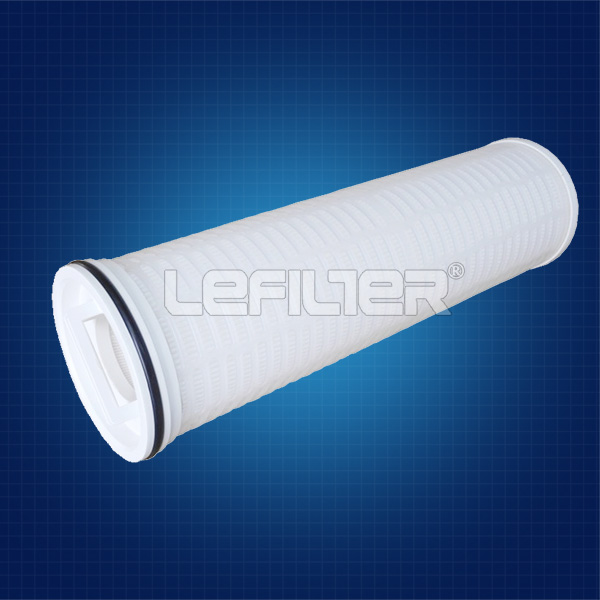
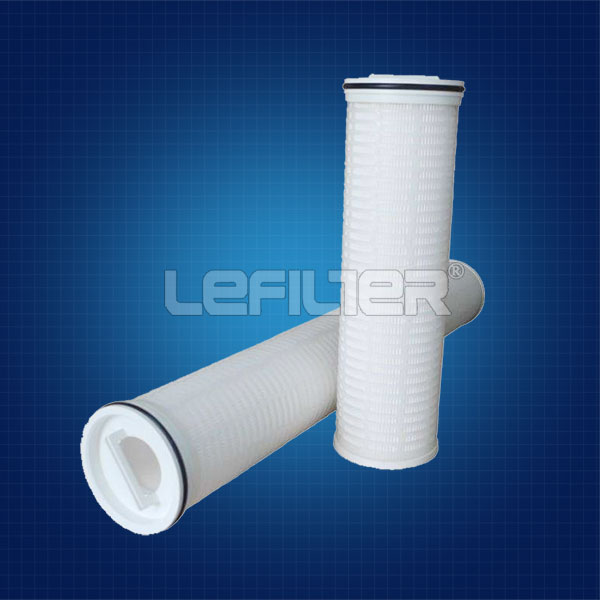
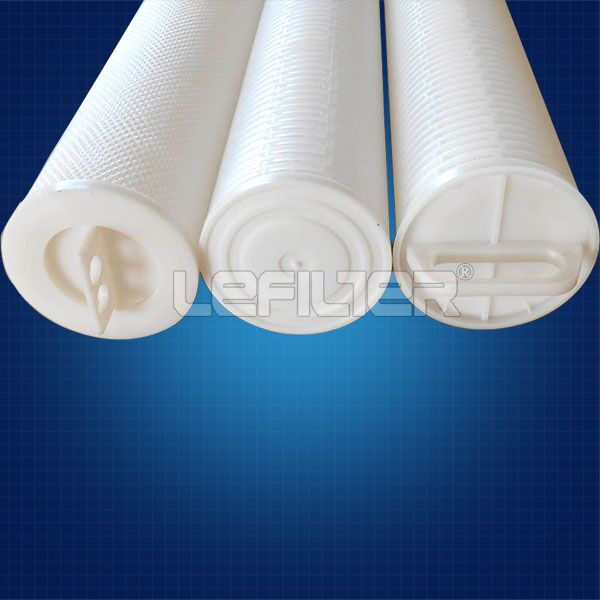
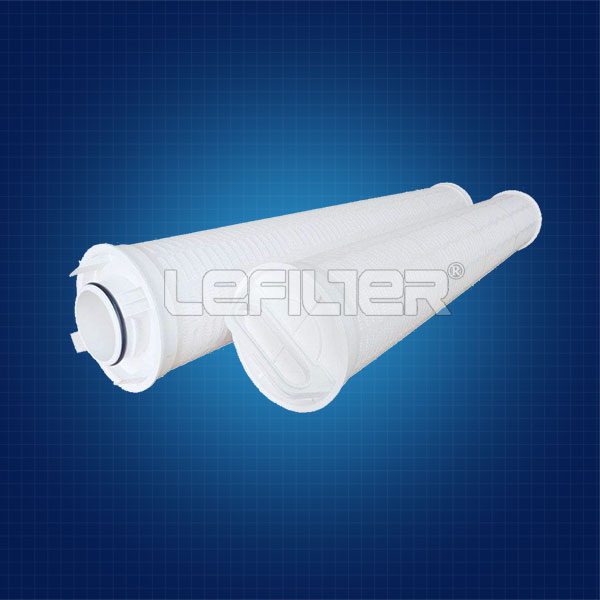
This high flow filter cartridge is a 6 in × 40 in single‑open‑end element intended for clarified juice and for syrup ahead of the crystallisers. Its defining feature in this service is not the rating but the area: at 70 °C a 68 Brix syrup has a viscosity near 60–100 cP, and pressure loss through a filter rises in direct proportion, so the element that survives a sugar duty is the one with the largest pleat area in the smallest housing. One element holds the area of five to seven conventional cartridges, which lets a water filter housing of two or three elements serve a syrup flow that would otherwise need a fifteen‑cartridge bank — and in a sugar house, floor space beside the evaporator station is the scarcest commodity there is. Where the juice side is screened ahead of liming, a self‑cleaning filter or a DSM screen removes bagasse and fibre before the cartridge sees them, because a fibrous load in a sugar duty is not a filtration problem but a blockage. Materials are food grade and the medium is binder‑free, so nothing sheds into a product stream that has no downstream barrier before crystallisation. The element is a compatible‑format replacement for large‑format high‑flow envelopes; it is not an original equipment part and carries no manufacturer endorsement.
Working Principle
Syrup enters the housing and passes from the outside of the pleat pack inward, so the retained precipitate stays on the upstream face and clear liquor reaches the core and the outlet.
Viscosity changes this duty more than any other variable, and it changes it in three ways.
First, pressure loss. In laminar flow through a porous medium, the pressure drop is proportional to viscosity. A medium that costs 3 psi at 20 °C in water costs 15–20 psi in 68 Brix syrup at 70 °C, at the same flow. This is why a syrup filter is oversized by water standards and why a cartridge chosen on its water rating will be declared "blocked" on its first day.
Second, capture. High viscosity suppresses turbulence and slows particle transport, so particles follow streamlines more faithfully and settle less. The consequence is favourable for efficiency — particles are carried into the medium rather than dropped in the housing — but it also means that a fine surface layer, once formed, is not disturbed and the pressure rise is monotonic.
Third, cleanability. Sugar solutions are nutrients. Any element that cannot be sanitised with hot water or low‑pressure steam will develop a biofilm within days, and that biofilm both blinds the medium and inoculates the downstream process with thermophilic spores — the organism group that ruins sugar at the crystallisation stage.
The precipitate itself is fine and mostly mineral: calcium carbonate from carbonatation, calcium sulphite from sulphitation, together with the occluded colloid and wax that the precipitate carried. Particles are in the 2–15 μm range, soft, and easily deformed. A graded medium holds them through depth rather than at the surface, which keeps the differential pressure curve flat for most of the element's life and then turns upward sharply when the depth is full — a signal that is easy to read and easy to trust.

Typical Specifications
| Parameter | Value |
|---|---|
| Element format | 6 in × 40 in, single open end, blind end cap |
| Filtration rating | 1–5 μm absolute; 5 μm for clarified juice, 1–3 μm for syrup ahead of crystallisation |
| Media | Binder‑free borosilicate glass microfibre, graded pleated structure |
| Core and cage | Polypropylene or PVDF; stainless cage for 90 °C syrup duty |
| Gasket | EPDM standard, FKM for continuous duty above 80 °C |
| Food contact | components compliant with FDA 21 CFR and EU 1935/2004; no fibre release |
| Maximum operating temperature | 100 °C (90 °C continuous) |
| Maximum differential pressure | 50 psi (3.4 bar) |
| Collapse / burst rating | 75 psi (5.2 bar) |
| Recommended change‑out differential | 15–25 psi (1.0–1.7 bar) |
| Flow per element, water basis | 150–350 gpm (34–80 m³/h) |
| Flow derating for syrup | 55–70 % of the water rating at 65–72 Brix, 70–80 °C |
| Housing | two‑ or three‑element 316L shell, jacketed where syrup temperature must be held |
| Target outlet quality | no visible precipitate; filtrate clear at 1:1 dilution against a white background |
Core Advantages
Area chosen for viscosity, not for water. The pleat pack is sized so that a 68 Brix syrup at 70 °C passes at 15 psi instead of 40, which is the difference between a working filter and a filter that gets bypassed.
Food‑grade, non‑shedding construction. Binder‑free media and a sealed cage mean no fibre enters a stream that goes straight to the pans, where a single filament becomes a crystal defect and a screen blockage.
Sanitisable with hot water. The element tolerates hot‑water and low‑pressure steam cycles, so a biofilm cannot establish itself between campaigns — the thermophilic spore problem starts in exactly this equipment.
One element replaces five to seven. A two‑element skid fits beside an evaporator station where a conventional bank would not, and the change takes minutes during a shift that cannot be spared.
Readable, monotonic differential pressure. Viscous flow produces a flat curve followed by a sharp rise; there is no ambiguity about when to change, and no tendency to change too early.
Application Scenarios
Clarified juice filtration between the clarifier and the evaporators, removing precipitate that escaped settling.
Syrup polishing ahead of the crystallisers in a raw sugar factory, where residual carbonate and evaporator floc must be held.
Refinery syrup filtration after decolourising columns, capturing carbon fines and resin fragments before the pans.
Remelt and affination syrup filtration in a refinery, where reworked material carries both precipitate and carbon.
Beet juice filtration after second carbonatation, where calcium carbonate fineness makes depth capture essential.
Molasses and high‑Brix stream filtration where viscosity, not solids, sets the element size.

Competitive Position and Replacement Notes
This element is an independent compatible replacement for large‑format high‑flow envelopes used in sugar juice and syrup filtration. Brand names and model designations referenced in this article, or in any cross‑reference table supplied with a quotation, are trademarks of their respective owners and are used only to describe dimensional and functional compatibility. There is no affiliation with, sponsorship by, or approval from any original manufacturer, and no original equipment parts are supplied.
A cross‑reference confirms envelope and connection. It does not confirm the properties that decide performance here: the medium's efficiency at 1–3 μm, the temperature rating of the core under continuous 90 °C service, the gasket compound, and the food‑contact documentation for every wetted component. Those four items should be verified in writing, because in this duty a wrong element does not fail visibly — it passes precipitate slowly, and the first sign is a pan that will not strike.
Selection Guide
Derate the flow for viscosity before sizing. Take the water rating, apply 55–70 % for 65–72 Brix syrup at 70–80 °C, and then add margin for the coldest start‑up, when viscosity is highest.
Set the rating from the downstream equipment. 5 μm absolute protects the evaporator and is normal for clarified juice; 1–3 μm is used ahead of crystallisation and after a carbon column.
Confirm the temperature rating for continuous service, not peak. A syrup line runs hot for weeks at a time, and a core rated for intermittent 100 °C will creep.
Specify the jacket. A syrup filter that cools between batches will crystallise sugar inside the housing, and the next start‑up will find a solid plug.
Design for sanitation from the start: drainable housing, hot‑water connection, and no dead legs. If the element cannot be sanitised in place, it will be sanitised never.
Plan element handling as a food operation — gloves, a covered area, and a documented change log. This is a food plant, and the filter room is part of the process.
Installation and Maintenance Notes
Flush the housing with hot water before the first element and after every change. Sugar left in a drained housing crystallises, and crystallised sugar in a dead leg is a permanent seed for the next batch.
Fill slowly and vent. In a viscous stream an air pocket does not migrate out on its own; it sits in the pleats, reduces area and reads as a blocked element within an hour of start‑up.
Change on the differential pressure trend, not on a calendar. In this duty the curve is flat for a long period and then steep; a scheduled change either wastes elements or runs them into bypass.
Never wash and reuse an element from a syrup duty. The retained precipitate is embedded in the medium along with sugar, and any washing that removes it also disturbs the graded structure. The element is consumable, and the cost per tonne of sugar is small against a pan that will not strike.
FAQ
Q1. Why does the same element flow so much less in syrup than in water?
A1: Because pressure loss scales with viscosity. At 68 Brix and 70 °C, syrup is 60–100 times more viscous than water, so the flow at a given pressure drop falls correspondingly. Sizing on the water rating is the most common error in this duty.
Q2. Does the element remove colour?
A2: No. Colour in sugar liquor is dissolved and is removed by carbonatation, bone char, granular carbon or resin. The cartridge removes suspended precipitate and fines, and its value is the protection it gives to the equipment that does the decolourising.
Q3. Can the element be steamed in place?
A3: Low‑pressure steam and hot water are both acceptable within the temperature rating; steam at pressure is not, because the differential pressure across a wet element can exceed the collapse rating. Follow the housing manufacturer's sanitisation procedure.
Q4. What rating suits syrup ahead of the pans?
A4: 1–3 μm absolute. Below that the element loads too quickly at high viscosity; above it, residual carbonate reaches the crystallisers and shows up as grain defects.
Q5. How is fouling detected before quality suffers?
A5: By the differential pressure trend and by a daily clarity check on a diluted sample. In this duty a rising trend is the reliable early warning; a turbidity instrument on syrup is unreliable at high Brix.
Related Products
RTM61HF200E 60 Inch High Flow Filter Cartridge
HFU660UY200H13 Replacement High Flow Filter Cartridge
Pentair Aqualine ALN01‑60B Large‑Diameter High‑Flow Pleated Filter Cartridge
3M 5613503 HF90 Quick‑Connect 0.2μm High‑Flow Water Filter Cartridge
Please fill in your procurement needs and contact information