High Flow Filter Cartridge for Textile Dyehouse Effluent Reuse
Introduction:A dyehouse is a water factory that happens to make cloth. Dyeing and finishing a kilogram of fabric consumes 100–200 litres of water, and that water leaves the plant hot, alkaline, coloured, saline and full of fibre. Reuse is now the only route that makes economic sense in a plant facing water tariffs and discharge limits, and the reuse train nearly always ends in a membrane — ultrafiltration, then reverse osmosis — because colour and dissolved salt cannot be removed any other way. Everything upstream of those membranes exists to keep them alive, and the cartridge stage is the last line: it must hold the residual fibre, the floc that escaped the bioreactor and the colloidal dye aggregate that would otherwise foul or abrade the elements. It must do this at 60–80 °C, at pH values that would dissolve a cheap core, and against a solids load whose defining feature is that half of it is long, stringy and determined to wrap itself around anything in its path. This article covers a high flow cartridge for dyehouse effluent reuse, including construction, the fibre problem and how the element is built to survive it, typical specifications, advantages, application points, compatibility notes, selection criteria and the operating practice that decides whether the reuse train runs for years or for one season.
We're here to help:
Easy ways to get the answers you need.
Product parameter:
Product Introduction
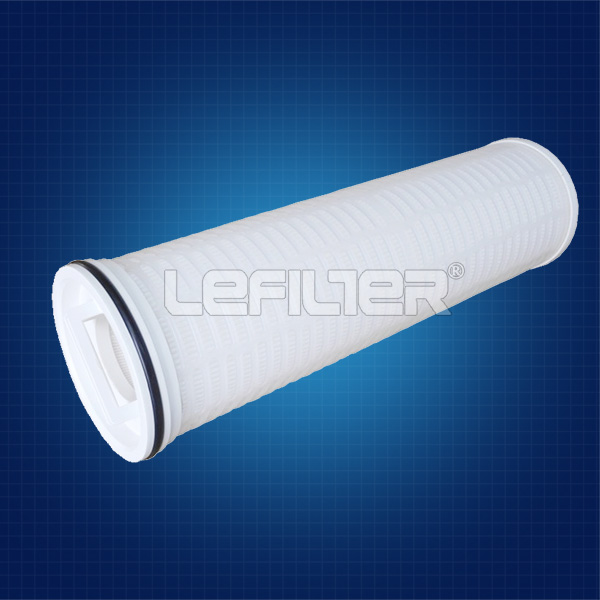
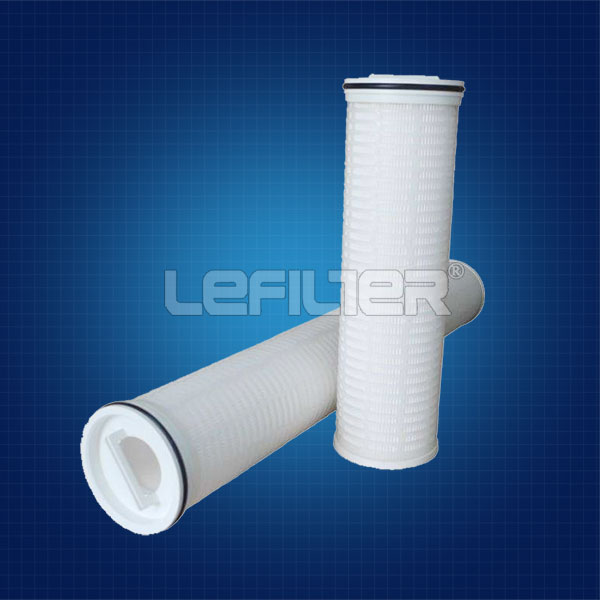
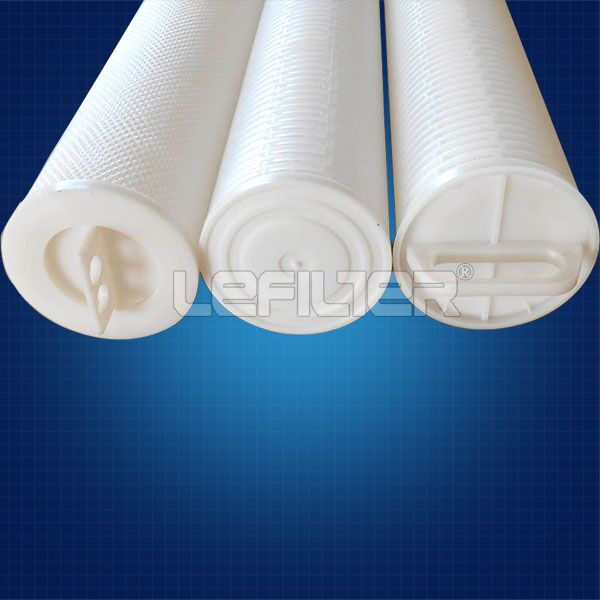
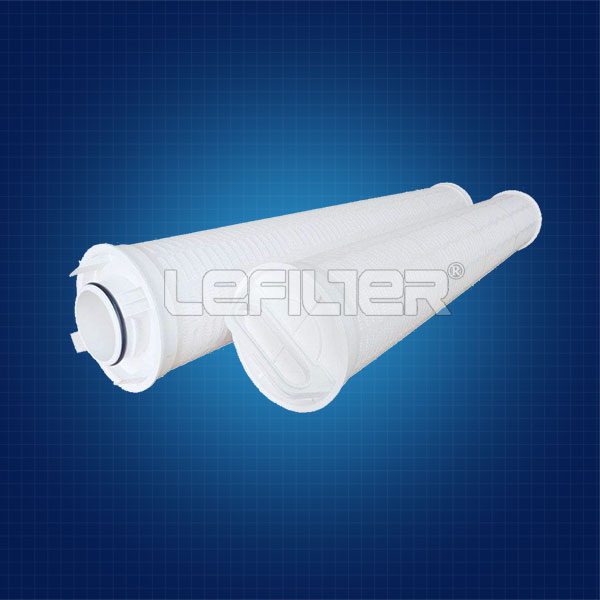
This high flow filter cartridge is a 6 in × 40 in single‑open‑end element for the polishing duty ahead of a reuse membrane. It is built with a high‑temperature tolerant core and a pleat geometry with wider spacing and a coarser upstream layer, both of which exist because the dominant foulant in this service is fibrous rather than particulate. One element passes 150–350 gpm (34–80 m³/h), which matters in a dyehouse for a reason that is rarely written down: fewer elements means fewer housings, fewer seals and fewer changes, and in a plant where the filter room is an afterthought staffed by whoever is free, the stage that is easiest to service is the stage that actually gets serviced. It sits in a water filter housing sized as a duplex pair so that one side can be changed while the reuse train keeps running, and it is protected — this is essential — by a self‑cleaning filter or a rotary drum screen upstream at 100–200 μm, because a cartridge cannot be asked to remove what a screen should have caught. The element is a compatible‑format replacement for large‑format high‑flow envelopes; it is not an original equipment part and carries no manufacturer endorsement.
Working Principle
Effluent enters the housing and passes from the outside of the pleat pack inward. Retained material stays on the upstream face and clean filtrate reaches the core, the outlet and the membrane stage.
In most filtration duties the deposit is a powder that builds an even cake. Here it is not. A dyehouse effluent after biological treatment still contains short fibres from the fabric, filament fragments from polyester and nylon, lint from the plant itself, and — where desizing liquor is in the mix — polyvinyl alcohol that behaves like a weak glue. These arrive at the element as a mixture of discrete particles and flexible strands, and strands behave completely differently from particles.
A strand that reaches a pleat does not stop at the surface. It lies across the pleat, extends into the neighbouring channel, and catches the next strand. Within hours a mat forms that bridges the pleat gaps, blinds the outer surface and drives the differential pressure up steeply — often from 8 psi to 30 psi in a single shift. Once the mat is established, the medium beneath it is no longer filtering; it is being compressed, and the pressure drop across the blocked area forces flow through the remaining open pleats, which then load faster.
Two design responses follow. Wider pleat spacing reduces the chance that a strand bridges from one pleat to the next before it is captured. A coarser outer layer lets the element hold the fibrous fraction in a loose structure near the surface, where it can be backwashed or at least removed with the element, rather than driving it into the fine layer where it would be impossible to dislodge. Neither measure makes a cartridge suitable for raw dyehouse liquor: the screen upstream is not optional, and a plant that removes it will discover the cost of that decision in membrane replacements.
The third mechanism is chemical. Dyehouse effluent after biological treatment typically sits at pH 8–10 and 40–60 °C, and hot dye liquor dumped into the drain can push a batch to 80 °C and pH 11 for a few hours. Polypropylene cores soften and creep under those conditions; a high‑temperature core and a gasket rated for the real excursion, not the average, are the difference between a three‑year element and a three‑week one.

Typical Specifications
| Parameter | Value |
|---|---|
| Element format | 6 in × 40 in, single open end, blind end cap |
| Filtration rating | 5 μm absolute standard; 1–3 μm where the downstream is UF |
| Media | Borosilicate glass microfibre or high‑temperature polypropylene, graded pleated structure with coarse upstream layer |
| Core and cage | High‑temperature polypropylene or PVDF; stainless cage option |
| Gasket | EPDM or FKM, pH and temperature tolerant |
| pH range | 2–12 continuous |
| Maximum operating temperature | 80 °C (60 °C continuous for standard media) |
| Maximum differential pressure | 50 psi (3.4 bar) |
| Collapse / burst rating | 75 psi (5.2 bar) |
| Recommended change‑out differential | 20–25 psi (1.4–1.7 bar), or on the first steep rise |
| Flow per element | 150–350 gpm (34–80 m³/h) |
| Housing arrangement | duplex pair in 316L, isolation valves, drain, differential gauge per side |
| Upstream requirement | rotary drum screen or self‑cleaning filter at 100–200 μm |
| Target outlet quality | no visible fibre; SDI below 4 for the downstream membrane |
Core Advantages
Built for strands, not powder. Wider pleat spacing and a loose coarse upstream layer stop the mat from bridging the pleats, which is the failure mode that ends most cartridge installations in a dyehouse.
High‑temperature and high‑pH construction. A core and gasket rated for 80 °C and pH 12 survive the hot caustic dump that a batch process produces, instead of creeping and collapsing on the first upset.
Fewer elements, fewer service events. One element replaces five to seven conventional cartridges, so a reuse skid has two change points instead of fourteen, and the stage gets serviced because servicing it is quick.
Duplex changeover under load. The reuse train keeps running while one side is changed, which removes the usual incentive to leave a loaded filter in place until the membrane starts to foul.
Low pressure loss at reuse flow rates. The plant's existing transfer pump can drive the polishing stage without a new booster, and the membrane feed pressure is unaffected.
Application Scenarios
Security filtration ahead of a UF or RO skid in a dyehouse reuse train, downstream of MBR or conventional biological treatment plus sand filtration.
MBR permeate polishing where membrane fibre and residual floc must be held before the reverse osmosis stage.
Desizing and scouring wastewater streams, where PVA and starch residues make the load gelatinous, ahead of the biological stage or a reuse loop.
Print‑room wash water recovery, where colour and thickener residues dominate.
Boiler feed and process water make‑up in a plant that reuses its own treated effluent, ahead of softening.
Batch dump equalisation outlet filtration, where a single hot, alkaline dump must be held before it reaches the biological stage.

Competitive Position and Replacement Notes
This element is an independent compatible replacement for large‑format high‑flow envelopes used in textile effluent reuse. Brand names and model designations referenced in this article, or in any cross‑reference table supplied with a quotation, are trademarks of their respective owners and are used only to describe dimensional and functional compatibility. There is no affiliation with, sponsorship by, or approval from any original manufacturer, and no original equipment parts are supplied.
A cross‑reference confirms the envelope, the end connection and the general duty class. It does not confirm the pH and temperature rating of the core, the pleat spacing that decides whether the element survives a fibrous load, or the gasket compound that decides whether it survives caustic. Those three details are the ones to verify in writing, against actual plant data rather than against a data sheet's nominal range.
Selection Guide
Fix the upstream screen before choosing the element. A rotary drum screen or self‑cleaning filter at 100–200 μm is the single measure that decides whether any cartridge survives this duty; a finer element downstream of a bad screen is money spent twice.
Set the rating from the downstream membrane. 5 μm absolute protects a UF element; 1–3 μm absolute is used where the filtrate goes directly to RO and the SDI limit is tight.
Verify temperature and pH in writing. Ask for the continuous rating, not the peak, and compare it with the hottest caustic dump the plant actually discharges, not with the average of the month.
Size for peak flow with one element out of service. A dyehouse reuse train runs at its maximum when several machines discharge at once, which is also when the solids load peaks.
Specify a differential gauge on each side of the duplex pair, with a local alarm. In this service the useful signal is the slope, and the change‑out trigger is 20–25 psi or the first steep rise, whichever comes first.
Plan the element disposal route. A loaded element from this duty is a coloured, odourous, chemically active object; it belongs in industrial waste, not in a general bin.
Installation and Maintenance Notes
Change on the slope, not on the number. A fibrous mat can take an element from 10 psi to 25 psi within one shift, so a weekly reading is too coarse; a daily check, or a gauge with a trend, is what catches it.
Do not attempt to clean and reuse a loaded element. A fibrous mat is entangled in the pleats, not sitting on them, and any washing that removes it also damages the medium. The element is consumable in this duty, and the budget should treat it that way.
Watch the outlet for fibre. A single filament in the filtrate means the medium has been breached, usually by a strand that penetrated the outer layer; the cause is normally a missing upstream screen rather than the element itself.
Keep the housing drained and flushed after each change. Residual dye liquor in a housing left standing will grow a biofilm that seeds the next element and shows up downstream as a rising membrane pressure.
FAQ
Q1. Can this element be used on raw dyehouse effluent?
A1: No. Raw liquor carries fibre, sizing agents and colour at concentrations far beyond a cartridge's capacity. Biological treatment plus a screen at 100–200 μm is the minimum upstream, and a UF stage is normal before RO.
Q2. Why does the differential pressure rise so fast here compared with other duties?
A2: Because the foulant is fibrous. Strands bridge the pleat gaps and blind the surface in a mat, which is a far faster process than cake build‑up from particulate.
Q3. Does the element remove colour?
A3: No, and no cartridge does. Colour is dissolved or colloidal and is removed by reverse osmosis or by adsorption; the cartridge's contribution is protecting the membrane that does the removing.
Q4. What temperature should be specified?
A4: The continuous rating should exceed the normal process temperature, and the peak rating should cover the hottest alkaline dump in the plant. For most dyehouses that means 60 °C continuous and 80 °C peak, with FKM seals.
Q5. How many elements does a typical reuse train need?
A5: At 150–350 gpm per element, a train of 0.5–2 MGD needs a two‑ or three‑element duplex bank — against 10–20 conventional cartridges in the same duty.
Related Products
RTM61HF200E 60 Inch High Flow Filter Cartridge
HFU660UY200H13 Replacement High Flow Filter Cartridge
Pentair Aqualine ALN01‑60B Large‑Diameter High‑Flow Pleated Filter Cartridge
3M 5613503 HF90 Quick‑Connect 0.2μm High‑Flow Water Filter Cartridge
Please fill in your procurement needs and contact information