High Flow Filter Cartridge for Municipal Drinking Water Polishing
Introduction:Conventional treatment — coagulation, clarification, rapid sand filtration, disinfection — reliably produces water in the 0.2–0.5 NTU range, and that is good enough for most regulatory limits on turbidity. It is not good enough for the two things that decide whether a distribution system is safe: the protozoan oocysts that survive chlorination, and the fine particulate that protects them, carries taste and odour compounds, and shields biofilm from disinfectant. Polishing filtration sits at the end of the treatment train, after the filters and often after granular activated carbon, and its job is to remove what the upstream process could not. A cartridge stage at that point must be made of certified materials, must survive continuous oxidant exposure, must not shed fibre into finished water, and must do all of this at the two or three psi of head that remains after a gravity filter. This article covers a high flow cartridge for municipal drinking water polishing, including construction, capture behaviour, typical specifications, advantages in this duty, application points, the honest limits of what a cartridge can and cannot be credited with, selection criteria and the operating discipline that keeps a polishing stage from becoming a source of contamination.
We're here to help:
Easy ways to get the answers you need.
Product parameter:
Product Introduction
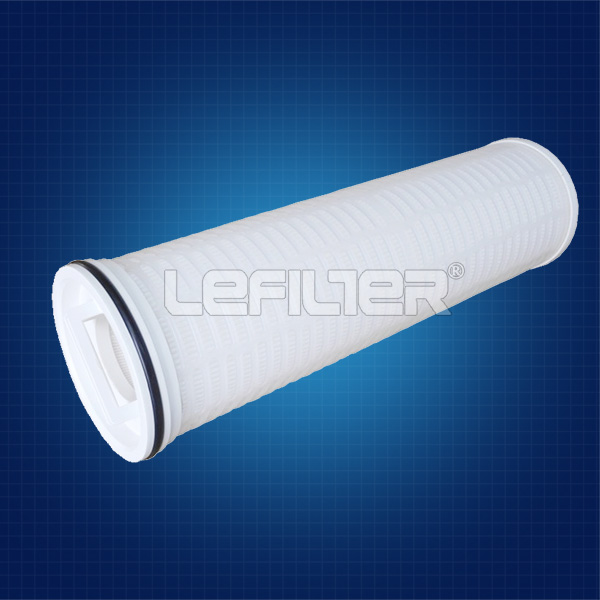
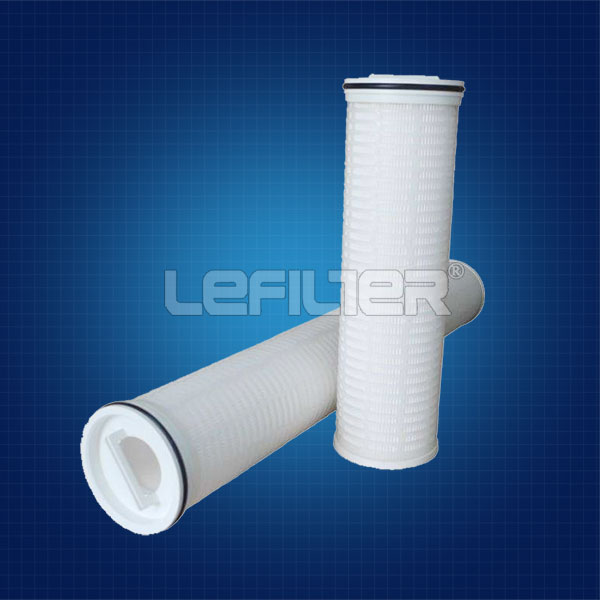
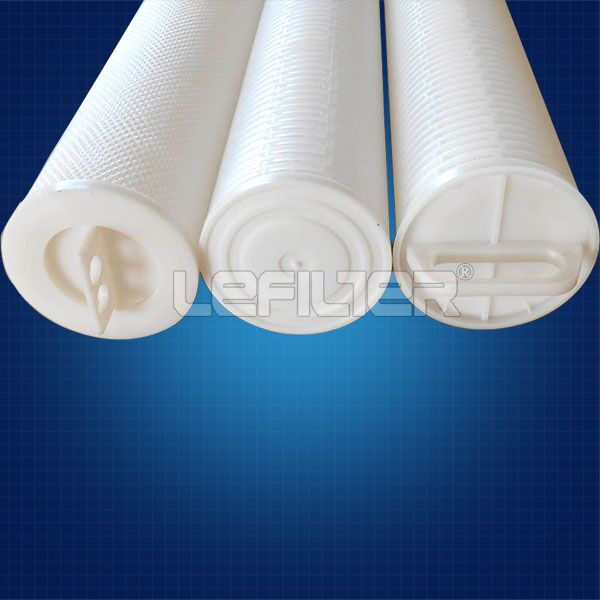
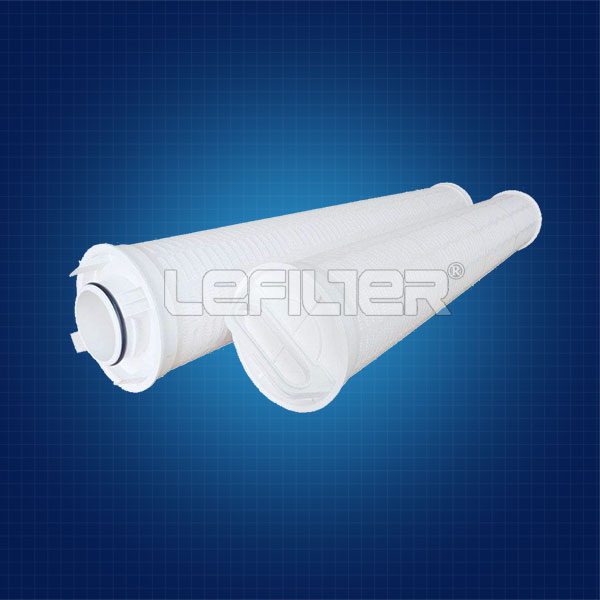
This high flow filter cartridge is a 6 in × 40 in single‑open‑end pleated element built for finished‑water duty: certified materials of construction, PVDF or binder‑free glass media depending on the oxidant regime, and a core and cage that will not corrode or shed. One element passes 150–350 gpm (34–80 m³/h) at a pressure loss small enough to be driven by the residual head after a gravity filter, which is the decisive advantage in a plant that has no spare pumping capacity. It is installed in a water filter housing sized as a two‑ or three‑element bank so that one element can be changed while the plant stays in service, and in a treatment train where the source is surface water a self‑cleaning filter ahead of the cartridge removes the coarse load — leaves, silt, filter breakthrough — so that the fine element is not spent on material the sand bed should have caught. The element is a compatible‑format replacement for large‑format high‑flow envelopes; it is not an original equipment part and carries no endorsement from any manufacturer.
Working Principle
Finished water enters the housing and passes from the outside of the pleat pack inward. Retained solids stay on the upstream face, clean water reaches the core and the outlet, and nothing accumulates where it could be flushed forward into the clearwell on a valve movement.
The particles here are small and low in concentration. After a well‑run sand filter the load is typically below 1 mg/L, dominated by particles in the 1–10 μm range: residual coagulant floc that escaped the bed, aluminium or iron hydroxide, finely divided carbon from a GAC adsorber, and the occasional diatom or clay platelet. There is nothing coarse enough to form a cake, so the medium must capture by depth filtration across a graded structure rather than by surface straining.
That distinction is why media construction matters more than nominal rating. A single‑layer medium rated at 1 μm will blind at the surface within a few weeks and then pass particles as the differential pressure forces them through. A graded medium — coarse upstream, fine downstream — lets the small load penetrate a little way into the structure, uses the whole thickness, and holds a stable efficiency until the differential pressure signal calls for a change.
The second mechanism that matters at a water plant is chemical rather than physical. Polypropylene is attacked by continuous free chlorine and by chlorine dioxide, and the failure mode is not dramatic: the fibre embrittles, the pleats crack, and the element begins to pass particles while still looking intact. PVDF and glass media withstand the oxidant levels found downstream of disinfection, which is why material selection in this duty is a compliance question rather than a preference.

Typical Specifications
| Parameter | Value |
|---|---|
| Element format | 6 in × 40 in, single open end, blind end cap |
| Filtration rating | 1 μm absolute standard; 0.5 μm and 2 μm options |
| Media | PVDF or binder‑free borosilicate glass, graded pleated structure |
| Core and cage | Polypropylene or PVDF; no metal in the flow path |
| Gasket | EPDM or FKM, NSF/ANSI 61 certified |
| Materials certification | NSF/ANSI 61 and NSF/ANSI 372 for all wetted components |
| Oxidant resistance | continuous free chlorine to 2 mg/L; chlorine dioxide and chloramine compatible with PVDF media |
| Maximum operating temperature | 40 °C (finished water is normally below 30 °C) |
| Maximum differential pressure | 50 psi (3.4 bar) |
| Collapse / burst rating | 75 psi (5.2 bar) |
| Recommended change‑out differential | 10–15 psi (0.7–1.0 bar) |
| Flow per element | 150–350 gpm (34–80 m³/h) |
| Target outlet quality | turbidity below 0.1 NTU; no fibre or visible particulate in a filtered sample |
Core Advantages
Runs on residual head. A large pleat area and a short flow path mean a two‑element bank can be driven by the 2–3 psi left after a gravity filter, without a new pump or a taller building.
Certified wetted materials. NSF/ANSI 61 and 372 certification covers every component in contact with finished water, which is the first question a regulator asks and the first thing an uncertified import fails.
Oxidant‑resistant media. PVDF or glass media hold their strength under continuous chlorination, where polypropylene would embrittle and start passing particles without any visible sign.
No fibre release. A binder‑free medium with a sealed cage does not shed into finished water, so the element cannot add turbidity or give biofilm a substrate.
One element replaces five to seven. A polishing skid fits into an existing filter gallery without a new footprint, which matters in a plant built decades before polishing was required.
Application Scenarios
Terminal polishing after rapid sand or dual‑media filtration, ahead of the clearwell and disinfection.
Post‑GAC filtration to capture carbon fines before the water reaches the distribution system.
Pre‑membrane security filtration ahead of a low‑pressure UF or NF skid, protecting the membrane from particulate that would foul it.
Small and mid‑size community plants where a membrane system is not economic but a 1 μm barrier is needed.
Filter‑to‑waste backwash water recovery, where the recovered stream is returned ahead of the filters.
Booster station and reservoir inlet filtration where finished water is re‑filtered before entering a sensitive distribution zone.

Competitive Position and Replacement Notes
This element is an independent compatible replacement for large‑format high‑flow envelopes used in drinking water polishing. Brand names and model designations appearing in this article, or in any cross‑reference table supplied with a quotation, are trademarks of their respective owners and are used only to describe dimensional and functional compatibility. There is no affiliation with, sponsorship by, or approval from any original manufacturer, and no original equipment parts are supplied.
Two points deserve plain statement. First, a cross‑reference confirms envelope and connection, not certification: any element offered for finished water must carry its own NSF/ANSI 61 documentation, and that documentation must be checked rather than assumed. Second, a cartridge filter is not a membrane. Unless a specific element has been validated under a recognised challenge‑test protocol, it does not earn protozoan log‑removal credit, and it should not be presented to a regulator as if it did. Its legitimate role is particle and turbidity control, membrane protection, and the reduction of the particulate load that disinfectant has to penetrate.
Selection Guide
State the objective before choosing a rating. Turbidity control, membrane protection and carbon‑fine capture are all served by 1 μm absolute; a 0.5 μm element is chosen only when a specific downstream requirement justifies the shorter life.
Match the medium to the oxidant regime, not to the price. Polypropylene in a chlorinated finished‑water line will fail by embrittlement, and the failure looks like media damage rather than a wrong selection.
Confirm certification per element, not per product family. Ask for the NSF/ANSI 61 listing that covers the exact model and the gasket compound.
Size on peak plant flow with one element out of service. A two‑element bank with one element loaded must still carry the design rate at an acceptable pressure loss.
Provide turbidity monitoring downstream and interlock it with the filter. A polishing stage that is not monitored is a stage that can fail silently for a month.
Design for clean handling. Elements should be changed with gloves, in a covered area, and the housing should be disinfected and flushed before the element is installed — finished water is a product, and the filter room is part of the process, not a workshop.
Installation and Maintenance Notes
Flush and disinfect the housing before the first element goes in. A new housing arrives with manufacturing residue and a used one arrives with whatever grew in it during the outage; neither belongs in finished water.
Fill slowly and vent completely. A housing filled from the top traps air in the pleats, which reads as a high differential pressure on a new element and tempts an operator to change it for no reason.
Watch turbidity, not only differential pressure. In this duty a rise in outlet turbidity before the differential pressure moves means a breach — a damaged gasket, a cracked pleat, an element installed in the wrong orientation — and it should be treated as a treatment failure, not a maintenance item.
Keep a log of the differential pressure at each change and the turbidity at the outlet. Over a year that log becomes the evidence that the polishing stage is working, which is what a sanitary survey asks for.
FAQ
Q1. Does a cartridge filter earn Cryptosporidium removal credit?
A1: Only if the specific element has been validated under a recognised challenge protocol. In general it does not, and it should not be claimed. Its value is particulate and turbidity control, which reduces the burden on disinfection and protects downstream membranes.
Q2. Why 1 μm rather than 5 μm?
A2: Because the load is already low and the target is below 0.1 NTU. A 5 μm element leaves the 1–3 μm fraction — the part that carries colour, metals and the smallest floc — in the finished water.
Q3. Can the element be used after chlorination?
A3: Yes, if the medium is PVDF or glass. Polypropylene is attacked by continuous free chlorine and will embrittle; the element then passes particles while appearing undamaged.
Q4. How is a polishing filter different from a membrane?
A4: A membrane is a continuous barrier with an integrity test; a cartridge is a depth medium with a defined rating. The membrane can be credited with pathogen removal, the cartridge generally cannot — but the cartridge costs a fraction as much and needs no backwash or permeate tank.
Q5. What happens if the element is changed without disinfecting the housing?
A5: Whatever was in the housing enters the finished water. In a plant with a clearwell contact time this may be masked; in a plant that filters directly to distribution it is a coliform risk. Disinfect, flush, then install.
Related Products
RTM61HF200E 60 Inch High Flow Filter Cartridge
HFU660UY200H13 Replacement High Flow Filter Cartridge
Pentair Aqualine ALN01‑60B Large‑Diameter High‑Flow Pleated Filter Cartridge
3M 5613503 HF90 Quick‑Connect 0.2μm High‑Flow Water Filter Cartridge
Please fill in your procurement needs and contact information