High Flow Filter Cartridge for District Heating Make-Up Water
Introduction:A district heating network is a very large volume of water held in several kilometres of insulated pipe, and it loses that water continuously through packing, expansion joints, buried pipe defects and every drain valve that is not quite shut. Make‑up water replaces those losses, and it arrives carrying exactly the things the network cannot tolerate: fine iron oxide, soft corrosion product, occasional hardness slip from a tired softener, and particles picked up in the make‑up tank and the pipe run between the treatment plant and the network. In a heat exchanger with plate gaps of 2–4 mm, a few grams of that material is enough to distort flow distribution and start under‑deposit corrosion. Filtration on the make‑up line is therefore not a polishing step added at the end; it is the point where the network's cleanliness is actually decided. This article covers a high flow cartridge for district heating make‑up water, including construction, capture behaviour, typical specifications, advantages in this duty, installation points, compatibility notes, selection criteria and the commissioning discipline that keeps a new pipe section from seeding the whole network.
We're here to help:
Easy ways to get the answers you need.
Product parameter:
Product Introduction
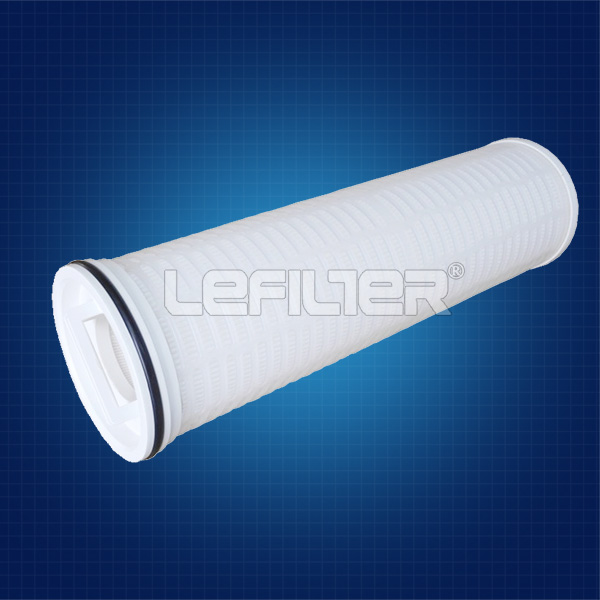
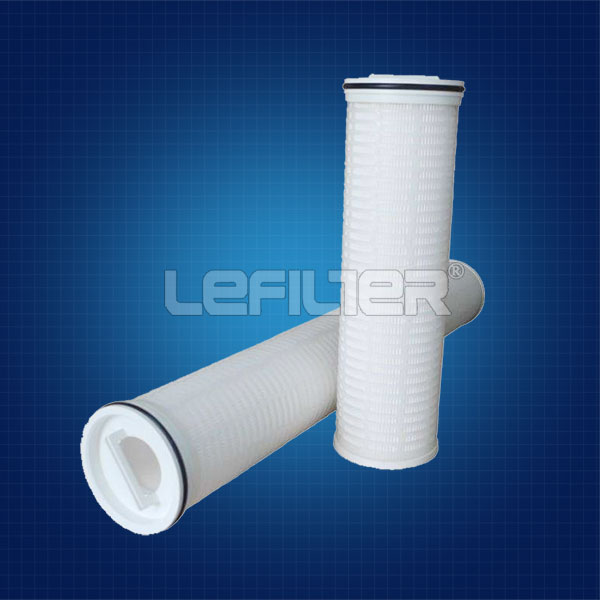
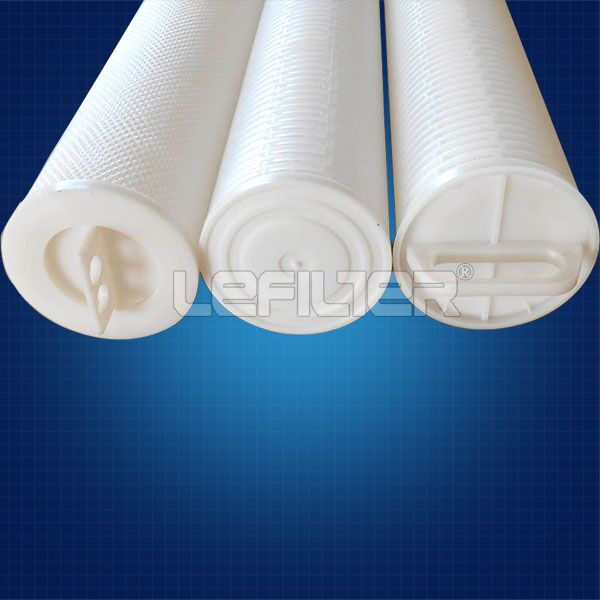
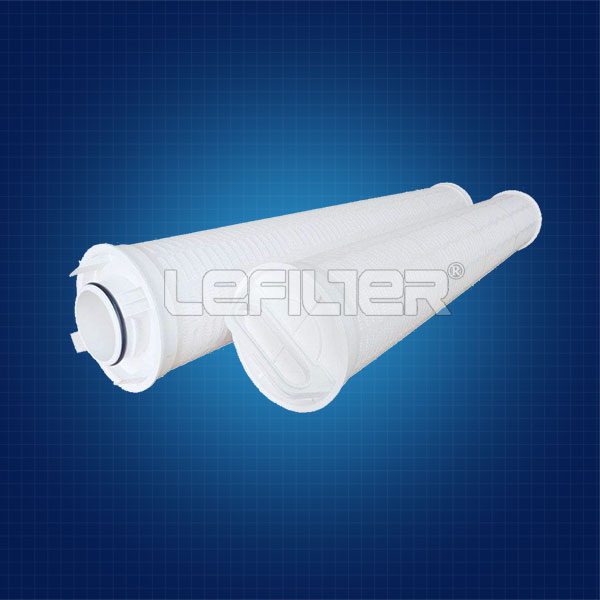
This high flow filter cartridge is a 6 in × 40 in single‑open‑end pleated element, sized so that one element passes the peak make‑up rate of a district heating substation at a few psi. It is mounted in a two‑element water filter housing arranged as a duplex pair with a changeover valve between them, which matters in this duty because make‑up water cannot be interrupted for an element change: the network is losing water whether or not the filter is in service, and a stopped make‑up line means falling pressure at the furthest substation. Where the make‑up water comes from a surface source, a well or a mixed supply, a self‑cleaning filter upstream removes the coarse load and lets the cartridge work on the fine fraction that actually reaches the plate packs. The element is a compatible‑format replacement for large‑format high‑flow envelopes; it is not an original equipment part and is supplied without any manufacturer endorsement.
Working Principle
Make‑up water enters the housing and passes from the outside of the pleated pack inward, so retained material collects on the upstream face and clean water reaches the core, the outlet and the network.
The distinctive feature of this duty is what the solids are. In a well‑run network, most of the fine material is magnetite — the black, dense, crystalline iron oxide that forms on the inner surface of carbon steel pipes wherever oxygen is absent. It is not a soft sludge. The particles are hard, angular, sub‑micron to a few microns, and they are held together loosely enough to detach in clusters whenever flow velocity changes. They are also magnetic, which is why a magnet on a drain valve will collect a black paste that looks like graphite.
Two consequences follow. First, the particles do not compress into a mat; they form a thin, dense, hard layer on the medium, and the differential pressure rises slowly and then more sharply once the surface is covered. Second, once deposited in a heat exchanger or a pipe low point, the material is extremely difficult to remove by flushing, and it sits directly on the metal where it supports under‑deposit corrosion — the classic failure mode in district heating, where a plate develops a pinhole under a patch of black deposit and the leak appears only at the start of the heating season.
A high flow element handles this because its pleat pack is wide, its media area is large, and its flow path is short. A 6 in element replaces five to seven 2.5 in × 40 in cartridges in the same housing footprint, which means the make‑up skid stays compact while the approach velocity across the medium stays low enough that magnetite is captured rather than driven through.

Typical Specifications
| Parameter | Value |
|---|---|
| Element format | 6 in × 40 in, single open end, blind end cap |
| Filtration rating | 5 μm absolute; 1–5 μm where plate heat exchangers dominate the network |
| Media | Borosilicate glass microfibre, pleated, binder‑free |
| Core and cage | Polypropylene standard; stainless steel for high‑temperature make‑up |
| Gasket | EPDM; FKM for make‑up above 90 °C |
| Maximum operating temperature | 100 °C (80 °C continuous) |
| Maximum differential pressure | 50 psi (3.4 bar) |
| Collapse / burst rating | 75 psi (5.2 bar) |
| Recommended change‑out differential | 15–25 psi (1.0–1.7 bar) |
| Flow per element | 150–350 gpm (34–80 m³/h) |
| Housing arrangement | duplex pair, 316L or carbon steel with epoxy lining, changeover valve, drain on each side |
| Target outlet quality | no particle above 5 μm; no visible black deposit on a white cloth sample at the outlet |
Core Advantages
Magnetite captured on the surface, not pushed through. Low face velocity and a fine absolute rating hold the hard, dense oxide particles that a nominal‑rated cartridge would pass under a pressure transient.
Duplex changeover without stopping make‑up. Two elements in parallel with a changeover valve let an element be replaced while the other carries the full peak rate.
Compact skid at network scale. One element replaces five to seven conventional cartridges, so a make‑up room that was built around a cartridge bank can carry a finer rating in the same space.
High‑temperature capability. A stainless cage and FKM seals allow the same element to serve hot make‑up or returned condensate up to 100 °C, which is beyond the range of a standard cartridge.
Readable differential pressure trend. A hard deposit produces a distinctive curve, and a sudden steepening tells the operator that something has entered the make‑up line before the heat exchangers see it.
Application Scenarios
Make‑up water filtration at a district heating substation, downstream of softening or demineralisation and ahead of the network connection.
Primary network side‑stream filtration in systems where the make‑up line is small relative to the loop volume and circulation is the only way to remove existing deposit.
Closed secondary loop filtration in building heating systems fed from a plate heat exchanger.
Boiler feed and return water filtration in a combined heat and power plant serving a network.
Condensate return filtration, where the same oxide particles return from the network at higher temperature.
Flushing and commissioning filtration after a new pipe section or a substation is tied in.

Competitive Position and Replacement Notes
This element is offered as an independent compatible replacement for large‑format high‑flow envelopes used on district heating make‑up lines. Brand names and model designations used in this article, or in any cross‑reference table supplied with a quotation, are trademarks of their respective owners and are used only to describe dimensional and functional compatibility. There is no affiliation with, sponsorship by, or approval from any original manufacturer, and no original equipment parts are supplied.
A cross‑reference establishes envelope, end‑connection and duty class. It does not establish media grade, efficiency at the critical particle size, gasket compound or collapse rating. For this duty the questions that decide service life are the absolute rating at 5 μm, the temperature capability of the seals, and whether the core and cage will survive a duplex changeover at full make‑up rate.
Selection Guide
Set the rating on the plate gaps, not on the make‑up rate. A 5 μm absolute element is the normal choice where plate heat exchangers carry the network; 1–3 μm is justified where a single exchanger serves a large connected load.
Size on peak make‑up, not average. A cold start after a summer shutdown or a burst main can draw three to five times the normal rate for hours.
Specify duplex with a changeover valve. A single housing on a make‑up line will eventually be left open or bypassed because nobody wants to interrupt the network for a filter change.
Confirm seal and cage materials against the maximum temperature actually seen. Hot condensate return at 95 °C will destroy an element rated for 60 °C, and the failure will look like media collapse rather than a material error.
Provide a differential pressure gauge on each side of the duplex pair, with the signal visible to the plant operator. The value of the filter is the trend, not the element.
Take the element out of the commissioning path. Flush new pipe sections to drain before they are tied in, and put the element in service only after the flush water is visibly clear.
Installation and Maintenance Notes
Fill from the bottom and vent from the top. Make‑up water carries dissolved gas, and a housing filled from the top will hold an air pocket in the pleats that reads as a high differential pressure on day one.
Change elements on differential pressure, and record the reading each time. Two numbers written down at each change build a history that will later explain a heat exchanger problem — or rule it out.
Keep a drain valve and a sampling point on the outlet side. A white cloth held in the sample stream is the cheapest and most convincing check of whether the filter is actually doing its job; black marks on the cloth mean the element is passing or bypassed.
Do not assume that a clean‑looking element is a good element. In this duty the retained material is a thin black film that may be invisible against grey media, yet it is exactly the mass that would have blocked a plate pack.
FAQ
Q1. If the make‑up water is already softened or demineralised, why filter it?
A1: Because softening removes hardness, not particles. Iron oxide from the tank, the pump and the pipe run passes straight through a softener, and that oxide is what deposits in heat exchangers.
Q2. Which rating is right for a network with plate heat exchangers?
A2: 5 μm absolute in most cases. Where a single large exchanger serves a critical load, 1–3 μm absolute is justified; the extra cost is small against one exchanger cleaning.
Q3. Can one element really handle a substation's make‑up rate?
A3: Yes. A 6 in × 40 in element passes 150–350 gpm, which covers the peak make‑up of most substations, and in a duplex pair the second element provides full standby.
Q4. What temperature can the element take?
A4: 100 °C maximum with a stainless cage and FKM seals; 80 °C continuous. Standard EPDM and polypropylene elements are limited to about 60 °C.
Q5. Why is the deposit black rather than brown?
A5: Because it is magnetite, Fe₃O₄, formed under low‑oxygen conditions in steel pipe. Brown material indicates oxygen ingress somewhere in the network, which is a separate problem worth investigating.
Related Products
RTM61HF200E 60 Inch High Flow Filter Cartridge
HFU660UY200H13 Replacement High Flow Filter Cartridge
Pentair Aqualine ALN01‑60B Large‑Diameter High‑Flow Pleated Filter Cartridge
3M 5613503 HF90 Quick‑Connect 0.2μm High‑Flow Water Filter Cartridge
Please fill in your procurement needs and contact information