High Flow Filter Cartridge for Semiconductor UPW Pre-Treatment
Introduction:Ultrapure water is built backwards from the specification. A fab needs water at the parts‑per‑trillion level for metals, below a few hundred ppt of total organic carbon and no particles above a stated size at the point of use — and every stage upstream exists to make the next stage possible. The cartridge that guards the reverse osmosis membranes is therefore not a commodity item: it decides the silt density index the membranes see, the organic load that reaches the carbon and the polishing trains, and, if it is the wrong construction, it becomes a source of the very fibres and extractables the fab is paying to exclude. This article covers a 6 in × 40 in single‑open‑end high flow cartridge for ultrapure water pre‑treatment, including construction, capture behaviour at low solids load, the extractables and shedding questions, typical specifications, advantages in this duty, application points, compatibility notes, selection criteria and the commissioning discipline this service requires.
We're here to help:
Easy ways to get the answers you need.
Product parameter:
Product Introduction
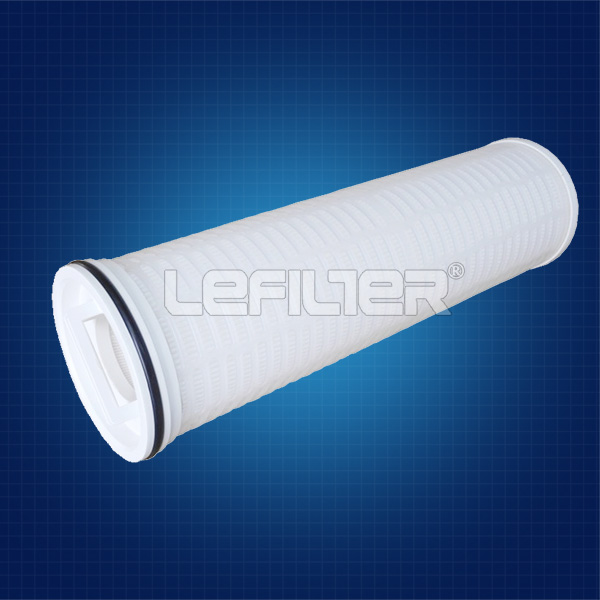
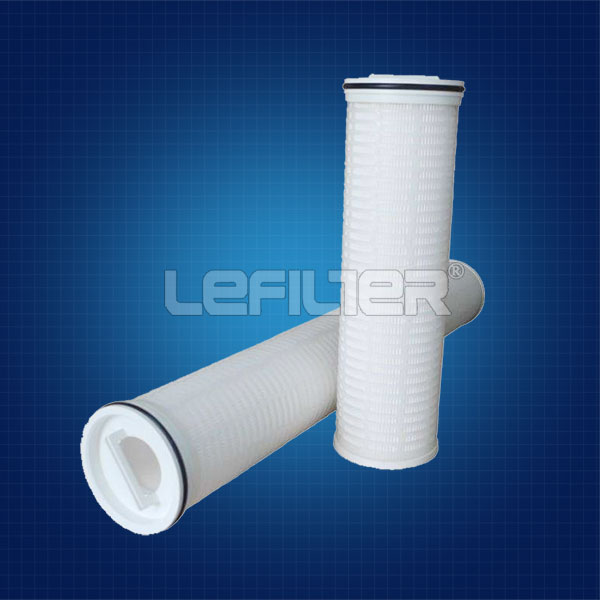
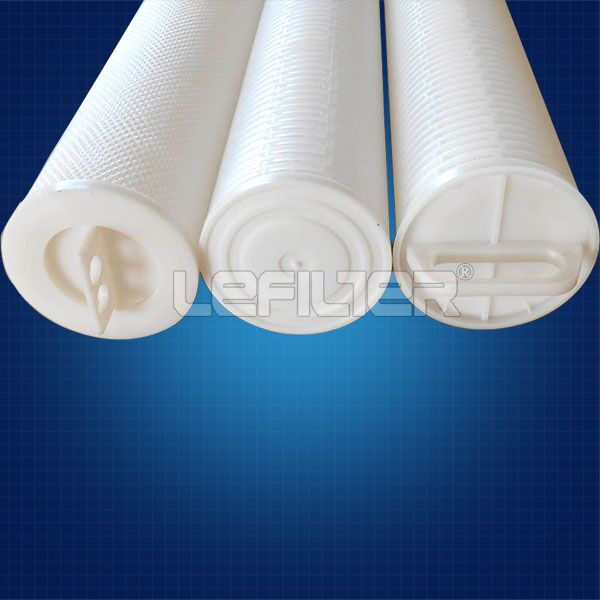
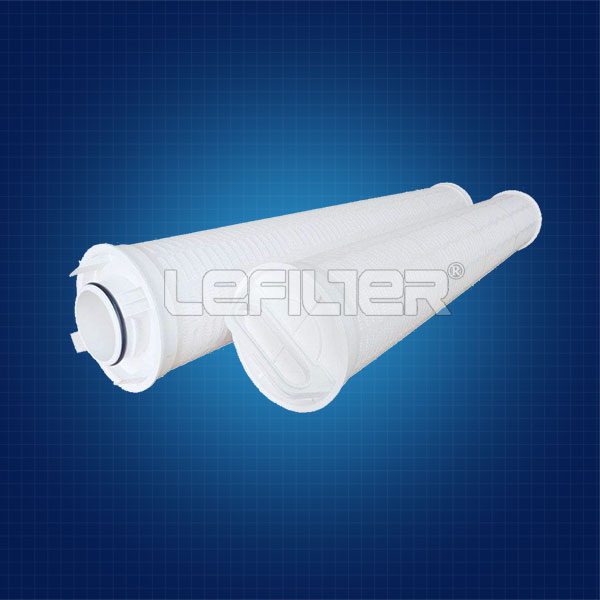
This high flow filter cartridge is a 6 in (152 mm) diameter, 40 in (1016 mm) long pleated element with a single open end and a blind opposite end, positioned after multimedia and carbon filtration and ahead of the reverse osmosis train. One element flows 150–350 gpm (34–80 m³/h) with a low clean differential pressure, so a compact water filter housing of two or three elements carries the full permeate feed of a mid‑size RO skid. Where the upstream multimedia or carbon vessels are backwashed on a fixed cycle and can shed a fines slug at the end of each run, a self‑cleaning filter placed ahead of the cartridge absorbs that slug so the pleats are not blinded once a day. Everything about the element in this duty is chosen for what it does not release rather than for what it removes, because the solids load is small and the consequences of contamination are large. The element is a compatible‑format replacement; it is not an original equipment part and carries no manufacturer endorsement.
Working Principle
Feed water enters the housing and passes from the outside of the pleated pack inward. Retained material stays on the upstream face, and clean water reaches the core and the RO feed header. In outside‑in flow nothing accumulates inside the core, so a start‑up surge cannot flush captured fines forward into the membranes.
The solids load here is low but fine and varied. Surface water or municipal supply carries clay and silt colloids in the sub‑micron range, iron and manganese oxide fines from pipe corrosion, and, after carbon beds, occasional carbon fines. Colloidal silica is the fraction that matters most for the RO stage: it is not removed by depth filtration in any complete sense, but a properly rated absolute element holds the agglomerated fraction and keeps the silt density index stable instead of drifting upward between backwashes.
Two constraints make this duty different from ordinary water filtration. The first is low extractables. Any binder, wetting agent, lubricant or adhesive in the element is a potential source of total organic carbon, and a surfactant‑wetted medium can raise TOC at the RO feed for days after installation. Elements for this service must be binder‑free, thermally bonded and pre‑wetted without surfactants. The second is no shedding: a pleated medium that releases fibre downstream is worse than no filter at all, because the fibre arrives where the fab has no further barrier.
The differential pressure signature is correspondingly flat. A clean element runs at a few psi and stays there for months; the useful signal is a slow upward drift, and the abnormal signal is a sudden step, which in this service usually means an upstream backwash carry‑over rather than genuine loading.

Typical Specifications
| Parameter | Value |
|---|---|
| Element format | 6 in × 40 in, single open end, blind end cap |
| Filtration rating | 1–5 μm absolute (0.5 and 10 μm available) |
| Media | Binder‑free borosilicate glass microfibre, pleated; no glue lines in the flow path |
| Upstream wrap | Melt‑blown polypropylene, thermally bonded, non‑shedding |
| Core and cage | Polypropylene, thermally bonded |
| Wetting | Pre‑wetted with water, no surfactants, no wetting agents |
| Gasket | EPDM, ultrapure grade; no silicone lubricant |
| Maximum operating temperature | 60 °C (ambient UPW pre‑treatment duty) |
| Maximum differential pressure | 50 psi (3.4 bar) |
| Collapse / burst rating | 75 psi (5.2 bar) |
| Recommended change‑out differential | 8–15 psi (0.6–1.0 bar) |
| Flow per element | 150–350 gpm (34–80 m³/h) |
| Housing | 2 or 3 element ASME shell in 316L, electropolished, with sanitary connections |
| Target outlet quality | SDI < 3 (typically < 2); turbidity < 0.1 NTU; no countable particles above rating |
Core Advantages
Low extractables by construction. Binder‑free media, thermal bonding and surfactant‑free wetting keep the element from adding TOC to a stream where TOC is measured in parts per billion and budgeted in parts per trillion.
No fibre release. A thermally bonded melt‑blown upstream wrap closes the media surface, so the element cannot shed the defect class it is installed to remove.
Stable SDI. Absolute ratings and a graded structure hold the fine colloidal fraction consistently, so the RO train sees a steady feed rather than a sawtooth between upstream backwashes.
Low and predictable pressure loss. A few psi clean differential pressure leaves the RO feed pump duty untouched and makes the change‑out signal unambiguous.
Cleanable, sanitary housing service. Electropolished 316L with sanitary fittings can be flushed, drained and returned to service without creating a biological niche.
Application Scenarios
RO feed guard filtration downstream of multimedia and carbon beds, where membrane warranty and cleaning frequency depend on a stable SDI.
Second‑pass RO feed and EDI feed polishing, where a single particle can damage a membrane or a resin bed.
Raw water intake filtration ahead of ultrafiltration, where colloidal load upsets the UF backwash cycle.
Reclaim and recycle loops in fabs with water reuse targets, where the recovered stream must be brought back to RO feed quality.
Boiler and cooling make‑up for the utility building, where the same skid protects a different downstream duty.
Pharmaceutical and microelectronics facilities sharing a UPW philosophy, where extractables and shedding rules are equally binding.

Competitive Position and Replacement Notes
This element is offered as an independent compatible replacement for large‑format high‑flow envelopes used in ultrapure water pre‑treatment. Brand names and model designations that appear in this article, and in any cross‑reference table supplied with a quotation, are trademarks of their respective owners and are used only to describe dimensional and functional compatibility. There is no affiliation with, sponsorship by, or approval from any original manufacturer, and no original equipment parts are supplied.
A cross‑reference confirms envelope, connection and duty class; it does not confirm media grade, efficiency curve, gasket compound, collapse rating, extractables or shedding behaviour. In this service the last two are the ones that decide acceptance. A supplier should be able to state the binder system, the bonding method, the wetting method and the test used to demonstrate that nothing is released downstream — and those statements should be verified in the fab's own water, not accepted as a general claim.
Selection Guide
Set the rating from the RO stage, not from a generic target. A 5 μm absolute element is the usual guard for spiral‑wound RO; 1 μm is used where the membrane cleaning frequency or the warranty demands it.
Ask for the extractables and wetting statement first. Anything specified with a surfactant wetting agent is unsuitable for UPW pre‑treatment regardless of its particle efficiency.
Verify the non‑shedding claim. Look for a thermally bonded upstream wrap and a bonding method that does not rely on glue lines exposed to flow.
Size for low differential pressure. In this duty the element should run at a few psi clean; a skid sized to a high clean pressure loss will mask the change‑out signal and load the RO feed pump.
Specify housing material and finish together with the element. Electropolished 316L with sanitary connections and a fully drainable low point is the baseline; a carbon steel housing undermines the element's cleanliness.
Plan the commissioning flush. New housings and new elements both need a defined flush to drain before the water is allowed forward to the membranes.
Installation and Maintenance Notes
Seat the element on the centre post and confirm the gasket is engaged before closing the lid; in a UPW plant a bypassing gasket shows up as a slow SDI drift that is easily blamed on the membranes.
Flush the housing to drain after every element change and before the water is forwarded. This is the step that removes handling debris and any residual from the element's own pre‑wetting.
Handle elements with clean gloves and keep them in their original packaging until the moment of installation. A cartridge that has been sitting open in a plant room has already collected what the fab is trying to exclude.
Trend differential pressure and SDI together. A rising differential pressure with a stable SDI means solids loading; a rising SDI with a flat differential pressure usually means a seal problem, an upstream upset or a membrane issue rather than the element.
FAQ
Q1. Is a 1 μm element always better than 5 μm for RO feed?
A1: No. Finer ratings raise differential pressure and change‑out frequency. Where the membrane is cleaned on a planned cycle and the SDI is already stable, 5 μm is the better economic choice.
Q2. Why does TOC rise after a filter change?
A2: Almost always because the element was wetted with a surfactant or contains a binder. In UPW duty the wetting method must be stated, and the element should be flushed before being put on line.
Q3. Can the element release fibres?
A3: A correctly built element does not: the upstream wrap is thermally bonded and the media is binder‑free. A cheap element with a glued wrap can shed, and the resulting defect is very hard to trace back to the filter.
Q4. How often should the element be changed?
A4: On differential pressure, not on a calendar. In clean service, life is often measured in months; the change‑out differential of 8–15 psi is reached slowly, and that slow rise is itself the useful trend.
Q5. Does the cartridge replace ultrafiltration?
A5: No. Ultrafiltration removes colloids and large organics; the cartridge is a guard for the RO membranes and a barrier against upstream carry‑over. The two stages answer different questions.
Related Products
RTM61HF200E 60 Inch High Flow Filter Cartridge
HFU660UY200H13 Replacement High Flow Filter Cartridge
Pentair Aqualine ALN01‑60B Large‑Diameter High‑Flow Pleated Filter Cartridge
3M 5613503 HF90 Quick‑Connect 0.2μm High‑Flow Water Filter Cartridge
Please fill in your procurement needs and contact information