High Flow Filter Cartridge for Steel Mill Descaling and Cooling Water
Introduction:In a hot strip mill two water systems decide surface quality, and both fail in the same way: a nozzle plugs. Descaling headers work at 150–250 bar and fire through orifices of a millimetre or two; a single piece of mill scale in that orifice leaves a strip of unremoved oxide that is rolled into the surface by the next stand. Laminar cooling headers are gentler but just as unforgiving: a blocked nozzle produces a cold streak, a distorted strip, and a shape rejection. The material that plugs both systems is the mill's own scale, plus oil and grease from the roll train. A filtration stage that catches it upstream is small, cheap and high‑leverage. This article covers a 6 in × 40 in single‑open‑end high flow cartridge for descaling and cooling water duty, including construction, capture behaviour with hard, plate‑like scale particles, typical specifications, advantages, application points, compatibility notes, selection criteria and the maintenance rules that keep a header clean.
We're here to help:
Easy ways to get the answers you need.
Product parameter:
Product Introduction
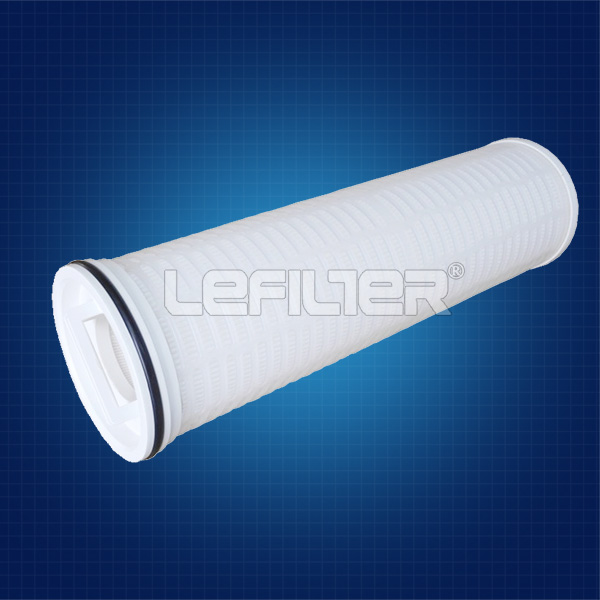
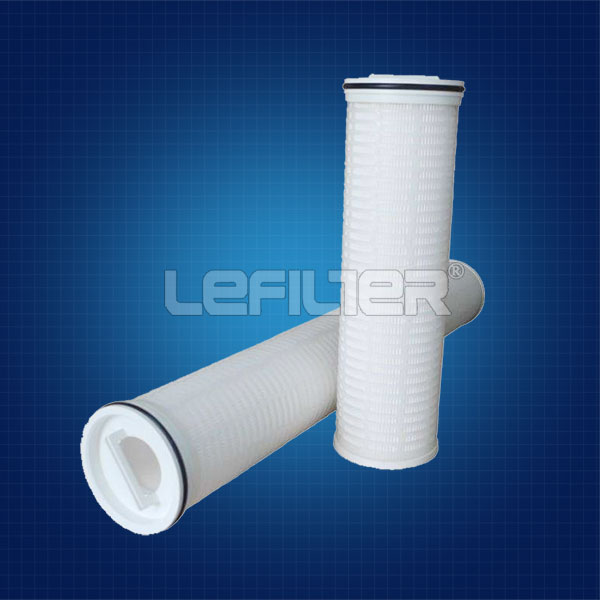
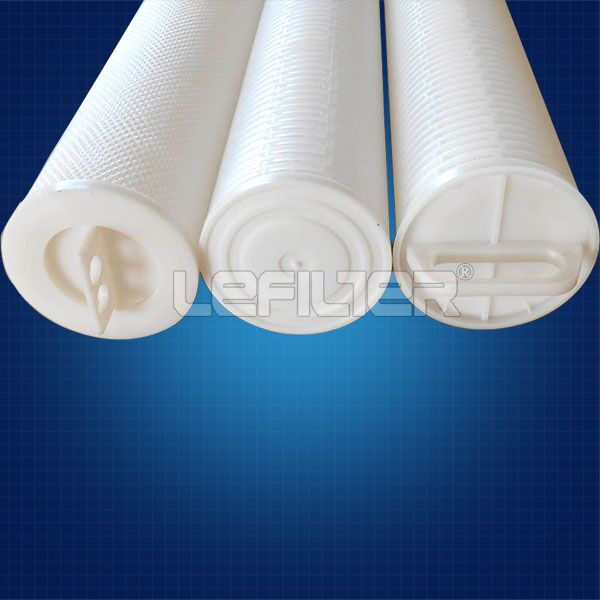
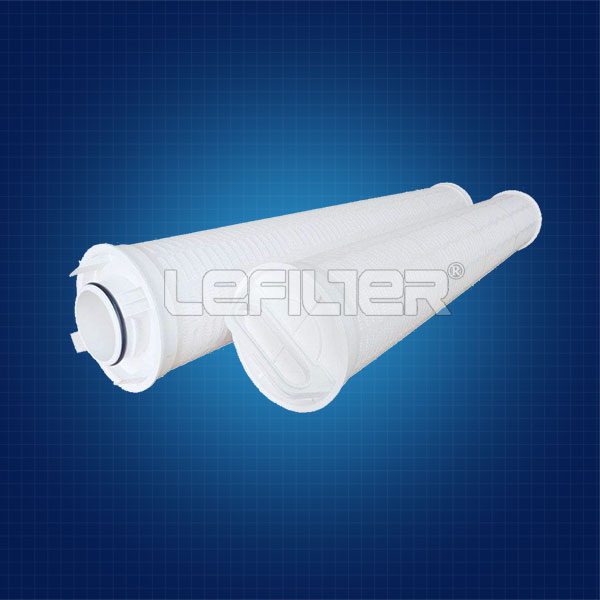
This high flow filter cartridge is a 6 in (152 mm) diameter, 40 in (1016 mm) long pleated element with a single open end and a blind opposite end. Its place in a steel mill is not the main descaling line — that is usually handled by a self‑cleaning strainer at coarse rating — but the guard stage behind it, and the cooling water circuits where flow is high and pressure budget is tight. One element flows 150–350 gpm (34–80 m³/h), so a two‑element water filter housing sits on the discharge of a cooling water booster pump or on a descale supply slipstream and protects a whole header bank. Where the upstream source is a scale pit or a lamellar clarifier that sheds slugs of oxide on its own cycle, a self‑cleaning filter ahead of the cartridge absorbs those slugs so that the pleats are not blinded in a single shift. The element is a compatible‑format replacement; it is not an original equipment part and carries no manufacturer endorsement.
Working Principle
Water enters the housing and passes from the outside of the pleated pack inward, so all retained material stays on the upstream face and only clean water reaches the core and the nozzles. That is the whole purpose: a nozzle does not care what is suspended in the header main, only whether a particle reaches its orifice.
Mill scale is a different load from the silt and algae of a cooling tower. It is hard, brittle and plate‑like, produced by the oxidation of hot steel and broken off by the descale jets themselves. Three consequences follow. First, these particles do not deform: they sit on the pleat surface as flat flakes and form a rigid, permeable cake rather than a soft mat, so differential pressure rises slowly at first and then steps up as flakes bridge and pack. Second, they are abrasive: a filter that lets them pass does not merely fail to protect the nozzle, it delivers a slurry that erodes the nozzle bore from the inside. Third, they settle fast. In a horizontal housing with low velocity, scale collects in the bottom of the shell and is picked up as a burst on the next start‑up, which is often what damages a freshly cleaned header.
Oil is the second load and the one that changes element life. Rolling oil, grease and hydraulic leakage wet the scale cake and bind it to the media, so the pleats blind at the tips while the shell is still half full of capacity. The differential pressure curve in this duty is therefore rarely smooth; a sudden rise usually means oil, not solids.

Typical Specifications
| Parameter | Value |
|---|---|
| Element format | 6 in × 40 in, single open end, blind end cap |
| Filtration rating | 5 μm absolute (1, 3, 10, 20 μm available); 10–20 μm for cooling water with large nozzles |
| Media | Graded borosilicate glass microfibre, pleated, with rigid upstream support layer for abrasive load |
| Core and cage | Polypropylene; reinforced cage for high‑pressure descale slipstream duty |
| Gasket | EPDM standard; fluoroelastomer where rolling oil is persistent |
| Maximum operating temperature | 80 °C (cooling water return and descale supply) |
| Maximum differential pressure | 50 psi (3.4 bar) |
| Collapse / burst rating | 75 psi (5.2 bar) |
| Recommended change‑out differential | 20–25 psi (1.4–1.7 bar) |
| Flow per element | 150–350 gpm (34–80 m³/h) |
| Housing | 2 or 3 element ASME shell in carbon steel with epoxy lining, or 316L |
| Target outlet quality | no particle above the nozzle orifice; turbidity < 1 NTU in cooling water |
Core Advantages
Nozzle protection where it counts. One or two elements guard a header bank at full flow without adding meaningful pressure loss to the booster pump, which is the only way a filtration stage survives in a mill's pressure budget.
Hard‑particle cake behaviour. A rigid support layer behind graded media holds plate‑like scale as a stable cake instead of letting flakes embed in the pleat valleys and tear the medium.
Abrasion resistance in the flow path. The upstream wrap keeps abrasive flakes off the fine layer until they are captured, which extends element life in a stream that is effectively a slurry.
Oil‑tolerant structure. Deep pleats resist the collapse that an oil‑bound scale cake would otherwise cause at 20 psi differential.
Small footprint, easy retrofit. The skid fits beside a booster pump or under a platform, with a drain that can be routed to the scale pit rather than the aisle.
Application Scenarios
High‑pressure descale supply as a guard stage behind the main strainer, protecting header nozzles from flakes carried over after a strainer backwash.
Laminar cooling headers on hot strip mills, where a plugged nozzle produces a cold streak and a shape defect.
Run‑out table cooling and strip cooling water on plate and coil lines.
Continuous caster secondary cooling, where nozzle blockage changes the solidification pattern and can cause a breakout.
Roll‑cooling and back‑up roll cooling circuits, where grease carry‑over is the dominant blinding mechanism.
Reclaimed water from a scale pit or lamellar clarifier feeding any of the above, where the clarifier's carry‑over must be caught before the headers.

Competitive Position and Replacement Notes
This element is offered as an independent compatible replacement for large‑format high‑flow envelopes used on steel mill water systems. Brand names and model designations that appear in this article, and in any cross‑reference table supplied with a quotation, are trademarks of their respective owners and are used only to describe dimensional and functional compatibility. There is no affiliation with, sponsorship by, or approval from any original manufacturer, and no original equipment parts are supplied.
A cross‑reference confirms envelope, connection and duty class; it does not confirm media grade, efficiency curve, gasket compound or collapse rating. In descaling and cooling water service the decisive properties are the medium's resistance to abrasive flakes, the rigidity of the pleat pack under an oil‑bound cake, and the housing lining. All three should be stated in the enquiry rather than assumed from a brand equivalence.
Selection Guide
Separate the two duties before sizing. Descale supply is a high‑pressure, low‑flow‑per‑nozzle duty; laminar cooling is a large‑flow, low‑pressure duty. They need different ratings and often different skids.
Set the rating from the nozzle bore, not from a general water quality target. A 5 μm absolute element protects sub‑millimetre nozzles; 10–20 μm is adequate for large laminar cooling orifices.
Check the upstream strainer's backwash behaviour. If it sheds a slug at the end of each cycle, place the cartridge downstream of a buffer volume or add a self‑cleaning stage.
Specify the cage and support layer for abrasive load. Standard cages are adequate for cooling water; descale slipstream duty justifies the reinforced option.
Include the housing lining in the enquiry. Epoxy‑lined carbon steel is normal; unlined carbon steel in a scale‑bearing stream corrodes and the corrosion product becomes a new blinding agent.
Agree the change‑out differential and the drain route at the design stage. A skid that cannot drain to the scale pit will be bypassed within a month.
Installation and Maintenance Notes
Seat the element on the centre post and confirm the gasket is fully engaged before closing the cover. On a high‑pressure descale slipstream a lifted gasket does not leak visibly; it sends unfiltered water to the header nozzles and shows up as a strip defect two stands downstream.
Fill slowly and vent completely. A fast fill fluidises the scale that has settled in the shell and drives it straight through the medium — the single most common cause of a "new element passed scale" complaint.
Log differential pressure daily. In this duty a step change is more informative than the absolute value: a sudden 5 psi rise means an oil or grease slug, and should trigger a look at the roll cooling circuit rather than a filter change.
Clean the housing's low point at every change‑out. Scale settles there and hardens; a housing that is not cleaned will pass its accumulated flakes on the first start after a new element is fitted.
FAQ
Q1. Does this element replace the descale strainer?
A1: No. The strainer handles the bulk scale load at coarse rating and backwashes itself. The cartridge is the fine guard behind it, sized to the nozzle bore.
Q2. Why do nozzles still plug after fitting a filter?
A2: Three usual reasons: the element has been run past its change‑out differential, a cover gasket is bypassing, or the housing low point was not cleaned and passed its settled scale on start‑up.
Q3. Is a finer element safer for the descale header?
A3: Only up to the nozzle bore. Below that, the pressure drop and change‑out frequency cost more than the protection, and the higher loading can cause more frequent starts during which scale is re‑entrained.
Q4. What does an oil slug do to element life?
A4: It wets and binds the scale cake, blinds the pleat tips and typically halves useful life. The fix is upstream — check roll cooling and hydraulic leakage — not a coarser element.
Q5. Can the same skid serve descale and cooling water?
A5: Rarely. The pressure classes and the acceptable pressure drop differ too much; a skid sized for cooling water will throttle a descale slipstream, and one sized for descale is oversized and expensive for cooling duty.
Related Products
RTM61HF200E 60 Inch High Flow Filter Cartridge
HFU660UY200H13 Replacement High Flow Filter Cartridge
Pentair Aqualine ALN01‑60B Large‑Diameter High‑Flow Pleated Filter Cartridge
3M 5613503 HF90 Quick‑Connect 0.2μm High‑Flow Water Filter Cartridge
Please fill in your procurement needs and contact information