High Flow Filter Cartridge for Paper Mill White Water Recovery
Introduction:White water is not waste; it is the largest single water stream on a paper machine, and every litre returned to the showers or the dilution lines saves fresh intake water and heat. The obstacle is what travels with it: fibre fines too short to sheet, filler particles, sizing and starch, and pitch that softens when the temperature drops. These materials choke shower nozzles, load felt conditioning headers, and build deposits on foils and save‑all internals. A filtration stage placed between the recovery unit and the point of reuse removes them at full flow, in a footprint small enough to retrofit beside an existing white water chest. This article covers a 6 in × 40 in single‑open‑end high flow cartridge for white water recovery duty, including construction, capture behaviour in a fibre‑laden stream, typical specifications, advantages, application points, compatibility notes, selection criteria and the shutdown risks that make this stage worth monitoring.
We're here to help:
Easy ways to get the answers you need.
Product parameter:
Product Introduction
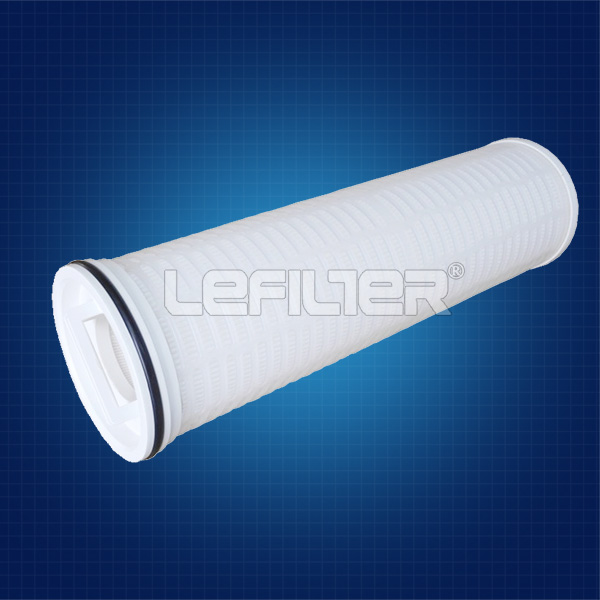
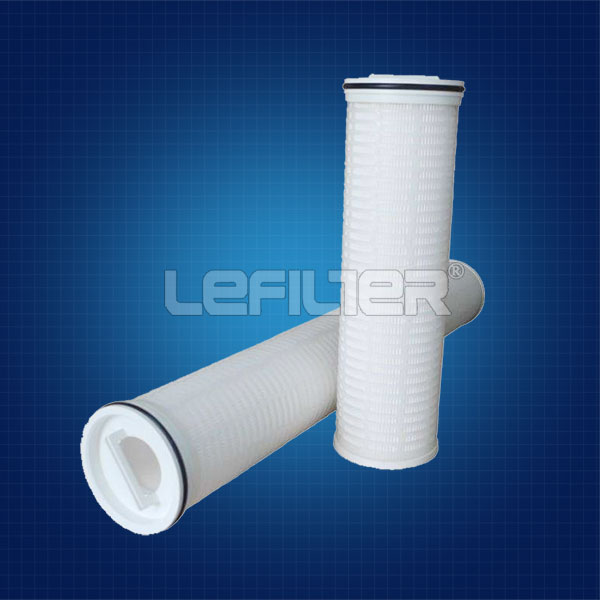
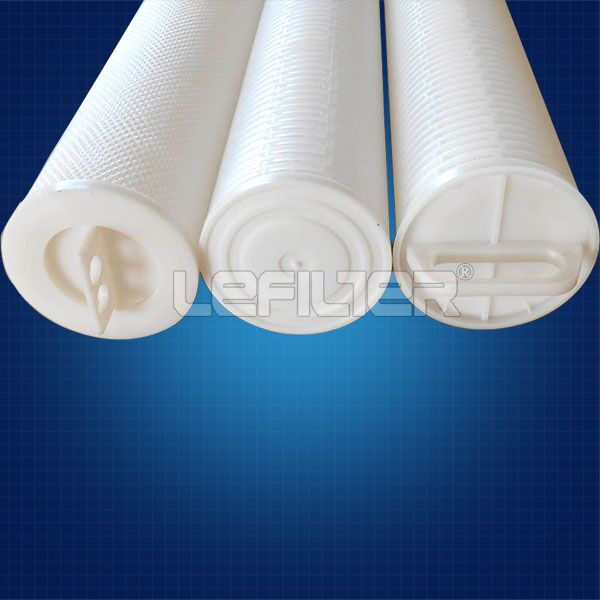
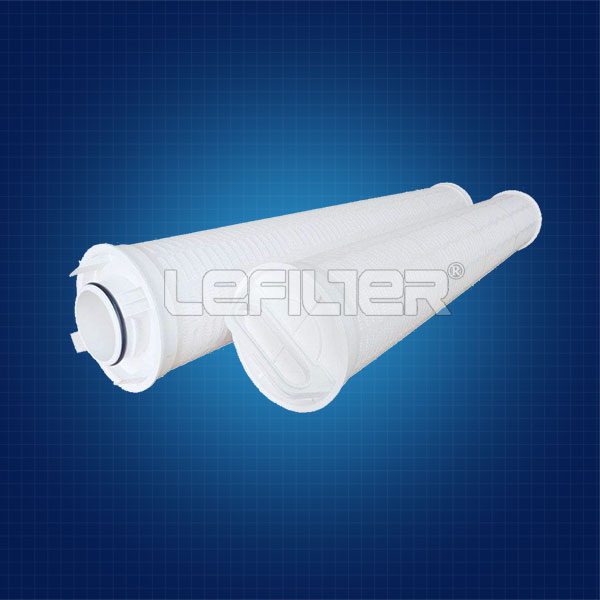
This high flow filter cartridge is a 6 in (152 mm) diameter, 40 in (1016 mm) long pleated element with a single open end and a blind opposite end. One element flows 150–350 gpm (34–80 m³/h) at a low differential pressure, which is what makes it usable on a shower water line where a conventional 2.5 in basket would need a dozen cartridges and a tall housing. A two‑element water filter housing fits on the machine floor beside the clarified water chest, and where the upstream save‑all is a flotation unit or a disc filter that sheds fibre slugs on its own cycle, a self‑cleaning filter ahead of the cartridge absorbs those slugs and keeps the pleats from being blinded in one shift. Retrofit is usually a matter of one tee, one skid and one drain: the existing shower pump stays, and the element sits on its discharge. The element is a compatible‑format replacement; it is not an original equipment part and carries no manufacturer endorsement.
Working Principle
Flow enters the housing and passes from the outside of the pleated pack inward, so everything retained stays on the upstream face and only clarified water reaches the core and the shower nozzles. This is exactly the behaviour the duty requires: a shower nozzle does not care how much fibre is in the chest, only whether a fibre reaches its orifice.
White water is a harder feed than its clarity suggests. It is warm, typically 40–60 °C, and it carries three classes of material that behave differently on a pleat. Fibre fines form a felt‑like cake: soft, highly compressible and, at first, quite permeable. Filler particles, calcium carbonate and clay, pack into that felt and reduce its permeability sharply. Pitch and stickies are the third class, and they are the ones that decide element life: they are soft at machine temperature and become tacky as the stream cools in the housing, so they glue the cake to the media and blind the pleat tips.
The practical result is a differential pressure curve that starts low, rises gently while the felt builds, and then turns upward when the filler packs and the pitch binds. Because the cake is compressible, a sudden flow increase compresses it further and can push already‑captured fines through the media; this is the mechanism behind the familiar pattern of "the showers were fine until we raised machine speed".

Typical Specifications
| Parameter | Value |
|---|---|
| Element format | 6 in × 40 in, single open end, blind end cap |
| Filtration rating | 5 μm absolute (1, 3, 10, 20 μm available); 10 μm for shower water with loose tolerances |
| Media | Graded borosilicate glass microfibre, pleated, with rigid upstream support layer |
| Core and cage | Polypropylene; polyester prefilter wrap for fibre‑heavy duty |
| Gasket | EPDM standard; fluoroelastomer where pitch and stickies are persistent |
| Maximum operating temperature | 80 °C (white water and clarified water duty) |
| Maximum differential pressure | 50 psi (3.4 bar) |
| Collapse / burst rating | 75 psi (5.2 bar) |
| Recommended change‑out differential | 15–25 psi (1.0–1.7 bar) |
| Flow per element | 150–350 gpm (34–80 m³/h) |
| Housing | 2 or 3 element ASME shell, 316L or carbon steel with internal coating |
| Target outlet quality | no visible fibre; turbidity < 1 NTU; nozzle‑safe at 5 μm absolute |
Core Advantages
Nozzle protection at machine flow. A shower header takes 150–300 gpm per bank; one or two elements protect it without throttling the pump or dropping shower pressure, which is what actually causes cross‑direction moisture profiles.
Fibre‑tolerant surface. A rigid support layer and a polyester wrap let the felt cake build without collapsing into the pleat valleys, so the element uses its area instead of blinding at the tips.
Pitch and stickies held at the surface. Because loading is entirely on the upstream face, tacky material leaves with the element rather than migrating into the core and re‑depositing downstream.
Small enough to retrofit. The housing sits on the machine floor or a small platform, close to the chest, so the added pipe run and the added pressure drop are both minimal.
Clear end point. A defined change‑out differential turns a vague "showers look weak" complaint into a scheduled maintenance action during a planned stop.
Application Scenarios
High‑pressure shower water for felt conditioning and fabric cleaning, where a single blinded nozzle shows up as a wet streak and then a break.
Low‑pressure showers on the forming section and the wire cleaning header.
Dilution water for headbox and for chemical addition points, where fibre carry‑over interferes with dosing accuracy.
Seal water and cooling water drawn from clarified white water.
Save‑all outlet polishing ahead of a reuse chest, where the flotation or disc unit's carry‑over must be caught.
Board and packaging machines running high filler loads, where the filler fraction in white water is the dominant blinding mechanism.

Competitive Position and Replacement Notes
This element is offered as an independent compatible replacement for large‑format high‑flow envelopes used on paper machine water systems. Brand names and model designations that appear in this article, and in any cross‑reference table supplied with a quotation, are trademarks of their respective owners and are used only to describe dimensional and functional compatibility. There is no affiliation with, sponsorship by, or approval from any original manufacturer, and no original equipment parts are supplied.
A cross‑reference confirms envelope, connection and duty class; it does not confirm media grade, efficiency curve, gasket compound or collapse rating. In white water service the two properties that decide success are the pleat pack's behaviour under a compressible felt cake and the gasket's resistance to pitch and stickies at machine temperature. Both should be specified explicitly rather than inferred from a brand claim.
Selection Guide
Decide which water the element protects. High‑pressure shower water, low‑pressure showers and dilution water have different nozzle sizes and therefore different acceptable ratings.
Set the rating from the smallest orifice in the circuit. A 5 μm absolute element is the usual choice for high‑pressure showers; 10 μm is adequate for low‑pressure headers with large nozzles.
Size on the shower pump's maximum flow, not its set point. Showers are often turned up after a machine speed increase, and an element sized on the original duty becomes the restriction.
Check the upstream save‑all's carry‑over behaviour. If the flotation unit sheds slugs, add a self‑cleaning or strainer stage rather than accepting frequent change‑outs.
Specify the gasket for pitch and stickies. EPDM is the default; fluoroelastomer where the machine runs coated or recycled furnish with high stickies content.
Confirm the housing position and drain route before ordering: the skid should be reachable from the machine floor and drainable without flooding the aisle during a change‑out.
Installation and Maintenance Notes
Seat the element on the centre post with the gasket fully engaged before closing the head. On a shower line a lifted gasket does not show as a leak; it shows as nozzles slowly plugging while the differential pressure still reads normal.
Fill the housing slowly. A fast fill compresses the felt cake and pushes captured fines through the media — the same mechanism that a sudden shower‑pump speed increase produces in service.
Log differential pressure daily and treat an accelerating rise as a pitch or stickies signal rather than a solids signal. In that case, check the upstream de‑inking or coating circuit before changing to a finer element, which will only blind sooner.
Where the machine runs with recycled furnish, keep a spare set of elements on the floor. A white water filter change‑out during a break is a fifteen‑minute job; the same job after a break is a web‑break investigation.
FAQ
Q1. Can this element replace the save‑all?
A1: No. It is a polishing stage. Fibre recovery and filler removal at grams per litre belong to flotation or disc filtration; the cartridge handles the residual that would otherwise reach the showers.
Q2. Why do nozzles plug even with a filter installed?
A2: Usually because the element has been run past its change‑out differential, or because a head gasket is bypassing. Check the differential and the seal before adding a finer rating.
Q3. Is a 1 μm element better for shower water?
A3: Not normally. Showers do not need sub‑micron clarity, and the pressure drop and change‑out frequency of a 1 μm element cost more than the protection is worth.
Q4. Does temperature matter?
A4: Yes. Pitch and stickies are more mobile at machine temperature and become tacky as the stream cools in the housing, which is why gasket compound and housing insulation both affect element life.
Q5. What happens if a change‑out is deferred?
A5: The felt cake compacts, the pleats blind, shower pressure falls at constant pump speed, and the moisture profile goes uneven. The visible result is a wet streak leading to a break, not a gradual quality loss.
Related Products
RTM61HF200E 60 Inch High Flow Filter Cartridge
HFU660UY200H13 Replacement High Flow Filter Cartridge
Pentair Aqualine ALN01‑60B Large‑Diameter High‑Flow Pleated Filter Cartridge
3M 5613503 HF90 Quick‑Connect 0.2μm High‑Flow Water Filter Cartridge
Please fill in your procurement needs and contact information