High Flow Filter Cartridge for Refinery Amine and Sour Water Service
Introduction:Amine treating units and sour water strippers share one weakness: both circuits are closed loops that lose performance slowly because of what circulates inside them. Iron sulphide, corrosion products and carry‑over hydrocarbons accumulate in the amine, where they promote foaming, fouling and erosion in the absorber, regenerator and reboilers; the same solids travel with sour water into the stripper, where they foul trays and packings and erode the feed/effluent exchanger. A properly placed filtration stage removes these fines early, at high flow, in a small footprint. This article covers a 6 in × 40 in single‑open‑end high flow cartridge for lean amine and sour water duty, including construction, capture behaviour in a wet, alkaline, sulphide‑bearing fluid, typical specifications, advantages in this service, application points, compatibility notes, selection criteria and the operating discipline that keeps filter life predictable.
We're here to help:
Easy ways to get the answers you need.
Product parameter:
Product Introduction
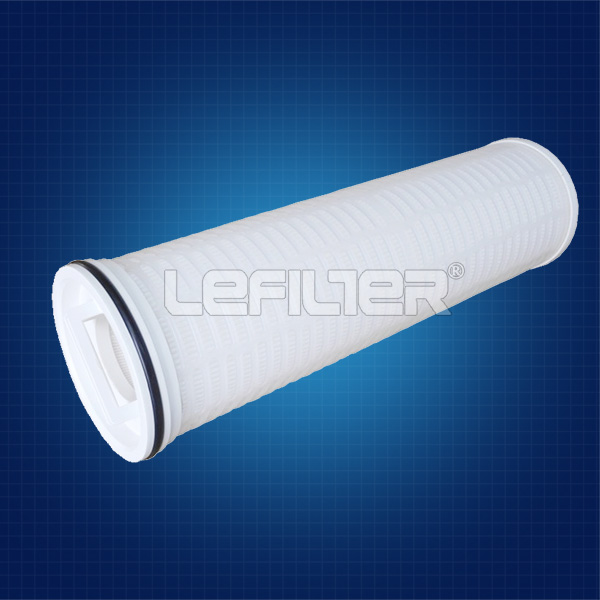
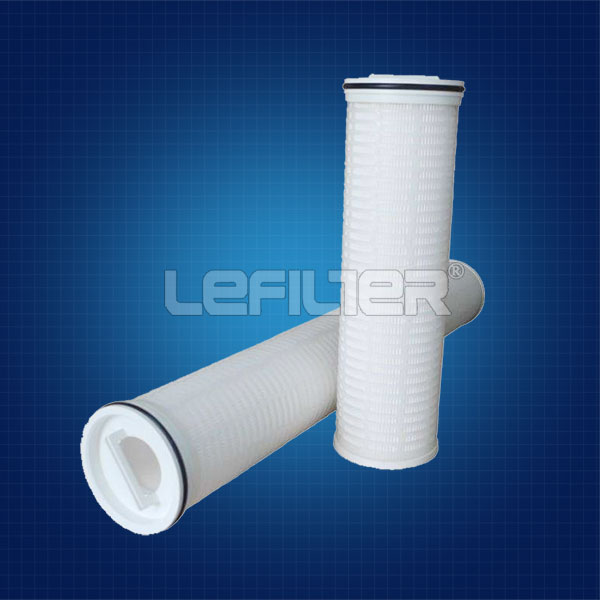
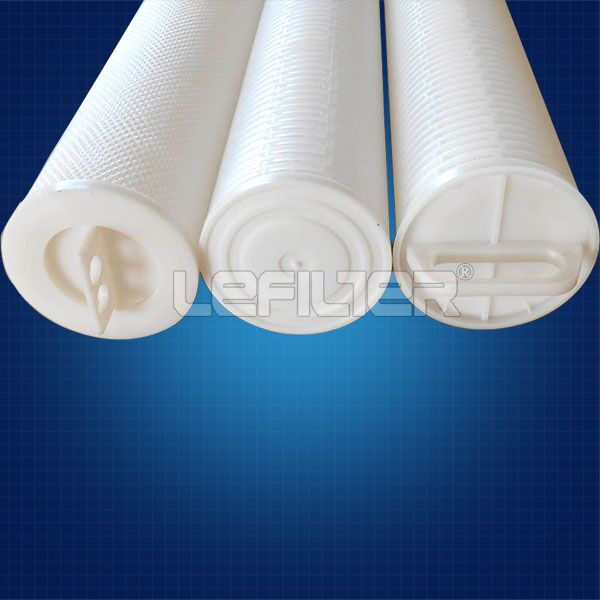
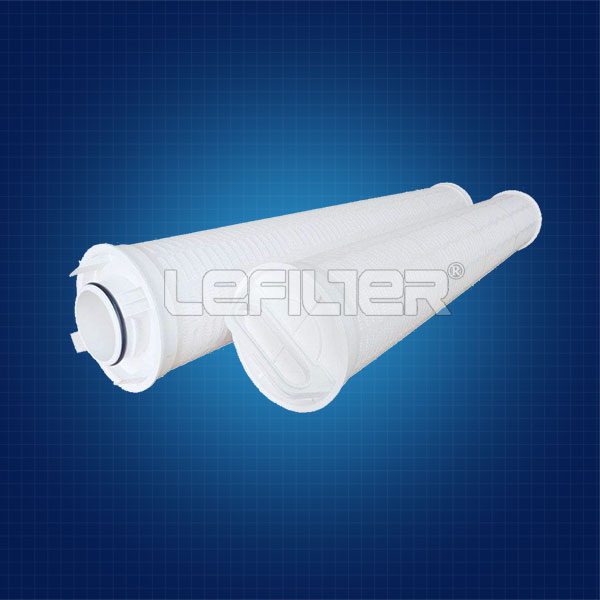
This high flow filter cartridge is a 6 in (152 mm) diameter, 40 in (1016 mm) long pleated element with a single open end and a blind opposite end, sized for the flow of an amine circulation loop or a sour water rundown line. One element passes 150–350 gpm (34–80 m³/h), so a two‑element water filter housing placed on a slipstream or in a duplex arrangement covers the duty of a full circulation pump without the pressure drop penalty of a large basket. Amine service is usually a slipstream take‑off ahead of the lean/rich exchanger, which is why the element is chosen for low pressure loss and stable efficiency rather than for maximum dirt holding; sour water service is closer to a full‑flow guard duty, and where the upstream unit is a media or strainer stage that must clear itself on a fixed cycle, a self‑cleaning filter ahead of the cartridge prevents slugs of scale and coke fines from blinding the pleats. The element is a compatible‑format replacement; it is not an original equipment part and carries no manufacturer endorsement.
Working Principle
Flow enters the housing, fills the annulus and passes from the outside of the pleated pack inward, so solids are deposited on the upstream face and only clean liquid reaches the core. In amine service this matters more than it sounds: any particle that reaches the core leaves with the lean amine and is carried into the absorber, the exchanger and the reboiler, where it deposits on hot surfaces and accelerates corrosion. Holding the fines on the outside of the element keeps them in a place that is removed at change‑out.
Two things distinguish this duty from ordinary water filtration. First, the fluid is alkaline and contains sulphide, so the fine fraction is dominated by iron sulphide and corrosion products rather than sand; these particles are soft, dark and easily re‑entrained if flow is reversed or the housing is drained too fast. Second, the fluid carries a small but persistent hydrocarbon fraction. Free hydrocarbon wets the pleat surface, binds the sulphide cake and blinds the pleat tips, which is why the differential pressure rise in amine service often accelerates well before the calculated solids capacity is reached.
The practical consequence is a cake that is compressible. Differential pressure in a clean element rises roughly linearly with load; in an oil‑wetted sulphide cake it rises faster than linear once the pleats begin to blind. Watching the shape of the curve, not only the number, tells the operator whether the load is solids, hydrocarbon or both.

Typical Specifications
| Parameter | Value |
|---|---|
| Element format | 6 in × 40 in, single open end, blind end cap |
| Filtration rating | 5 μm absolute (1, 3, 10, 20 μm available) |
| Media | Graded borosilicate glass microfibre, pleated, with rigid upstream support layer |
| Core and cage | Polypropylene, with polyester or glass fibre prefilter wrap |
| Gasket | EPDM standard; fluoroelastomer for hydrocarbon‑rich or high‑temperature lean amine |
| Maximum operating temperature | 80 °C (amine lean side and sour water stripper feed) |
| Maximum differential pressure | 50 psi (3.4 bar) |
| Collapse / burst rating | 75 psi (5.2 bar) |
| Recommended change‑out differential | 15–25 psi (1.0–1.7 bar), depending on loop sensitivity |
| Flow per element | 150–350 gpm (34–80 m³/h) |
| Housing | 2 or 3 element ASME shell, carbon steel with internal coating or 316L |
| Target outlet quality | suspended solids < 1–2 mg/L; free hydrocarbon essentially nil |
Core Advantages
Fines removed before they reach hot surfaces. Iron sulphide held on a pleat is a maintenance item; the same particle deposited on a reboiler tube is a turnaround item.
High flow in a small skid. A slipstream of 200–300 gpm through one or two elements is enough to keep a large amine loop clean, without adding a significant pressure drop to the circulation pump.
Graded media for a soft, fine load. Sulphide and corrosion fines are predominantly sub‑10 μm; graded glass fibre holds them without the surface blinding that a single‑layer fine medium suffers.
Hydrocarbon‑tolerant pleat structure. A rigid upstream support layer keeps deep pleats open when the cake is oil‑bound, so the element uses its full area instead of collapsing early.
Predictable differential pressure end point. A defined change‑out value, agreed at commissioning, is the difference between a controlled maintenance task and an unplanned absorber shutdown.
Application Scenarios
Lean amine filtration on gas treating and refinery amine units, on a slipstream ahead of the lean/rich exchanger.
Rich amine guard filtration where carry‑over hydrocarbons and sulphide fines are the dominant load.
Sour water stripper feed filtration ahead of the feed/effluent exchanger and the stripping column.
Amine reclaimer and reclaim feed service, where solids interfere with the reclaim chemistry.
Sour water rundown to treatment, where solids must be removed before biological or stripping stages.
Debottlenecking of units where the existing filtration is a strainer that passes exactly the particle size that causes the fouling.

Competitive Position and Replacement Notes
This element is offered as an independent compatible replacement for large‑format high‑flow envelopes used in amine and sour water service. Brand names and model designations that appear in this article, and in any cross‑reference table supplied with a quotation, are trademarks of their respective owners and are used only to describe dimensional and functional compatibility. There is no affiliation with, sponsorship by, or approval from any original manufacturer, and no original equipment parts are supplied.
A cross‑reference confirms envelope, connection and duty class. It does not confirm media grade, efficiency curve, gasket compound or collapse rating. In amine service the two properties that decide whether a compatible element actually works are the gasket compound and the pleat pack's resistance to an oil‑bound cake; these should be asked for explicitly instead of accepting a brand equivalence statement.
Selection Guide
Fix the filtration point before choosing the element. Slipstream lean amine filtration, rich amine guard duty and sour water stripper feed filtration have different solids loads and different acceptable pressure drops.
Size the slipstream, not the whole loop, on amine service. A 10–20 % take‑off is normally enough to hold solids at a steady state; full‑flow filtration is expensive and rarely justified.
Set the rating from the damage mechanism. Where the problem is exchanger and reboiler fouling, 5 μm absolute is the usual choice; where it is tray fouling only, 10 μm may give longer life at lower cost.
Choose the gasket compound from the actual hydrocarbon content and temperature, not from a generic data sheet. Fluoroelastomer is the safe default for hot lean amine with carry‑over hydrocarbon.
Verify the differential pressure instrumentation and its alarm point at commissioning. In a closed loop, an unmonitored filter simply becomes a bypass.
Confirm the housing's metallurgy and internal coating against the amine concentration and the sour water sulphide level; carbon steel with coating is common, 316L where the fluid is aggressive.
Installation and Maintenance Notes
Seat the element on the centre post and confirm the end‑cap gasket is fully engaged before closing the head; a lifted gasket in amine service bypasses the element and the loop continues to foul while the differential pressure reads low. Fill the housing slowly — a fast fill on a sulphide‑laden element re‑entrains the cake into the clean side.
Log differential pressure daily. Change out at the agreed value, or earlier if the rise becomes non‑linear: an accelerating curve means hydrocarbon binding, and continuing to run transfers the load to the exchanger.
Do not return a used element to service after inspection. Amine‑wetted media does not reseal reliably and its cake compacts on the second installation.
Where the housing is drained for maintenance, drain slowly and flush the low point before opening; sulphide fines settle there and become airborne on opening, which is both a contamination and a safety issue.
FAQ
Q1. Does filtration replace amine reclaiming?
A1: No. Filtration removes suspended solids and free hydrocarbon; heat‑stable salts and degradation products are a separate chemistry problem handled by reclaiming or ion exchange.
Q2. Why does the element load faster than the solids balance predicts?
A2: Because hydrocarbon carry‑over binds the cake and blinds the pleat tips. Check the upstream separation before changing element grade.
Q3. Can the same element serve lean amine and sour water?
A3: Mechanically yes; the gasket compound and the change‑out differential should be set separately, because sour water runs hotter and carries a different sulphide load.
Q4. Is a finer element always better for amine service?
A4: No. Below about 5 μm absolute, the pressure drop and change‑out frequency usually cost more than the additional protection is worth, unless the fouling mechanism is specifically sub‑micron.
Q5. What is the main risk of running past the change‑out differential?
A5: Pleat collapse near the 75 psi rating and release of the accumulated sulphide cake into the lean amine, which is precisely the material the filter was installed to keep out of the absorber.
Related Products
RTM61HF200E 60 Inch High Flow Filter Cartridge
HFU660UY200H13 Replacement High Flow Filter Cartridge
Pentair Aqualine ALN01‑60B Large‑Diameter High‑Flow Pleated Filter Cartridge
3M 5613503 HF90 Quick‑Connect 0.2μm High‑Flow Water Filter Cartridge
Please fill in your procurement needs and contact information