High Flow Filter Cartridge for RO Membrane Guard Filtration
Introduction:A guard filter is the last item installed before a high-pressure pump, and the only component in the whole pretreatment chain whose failure is measured in membrane replacements. It sits downstream of ultrafiltration, multimedia filtration or carbon, where the water looks clean and the remaining load is small, fine and easy to underestimate: resin fines, carbon dust, pipe corrosion products, occasional biological fragments carried through on an upset. Those particles do not foul a membrane slowly — they score the feed spacer, plug the element inlet and raise differential pressure in a way that no cleaning will reverse. This article covers a high-flow filter cartridge for RO membrane guard duty, covering construction, working principle with an emphasis on how the element captures and holds solids, typical specifications, advantages in guard service, application scenarios, compatibility notes, selection criteria and the differential pressure discipline that keeps the guard stage doing its only job.
We're here to help:
Easy ways to get the answers you need.
Product parameter:
Product Introduction
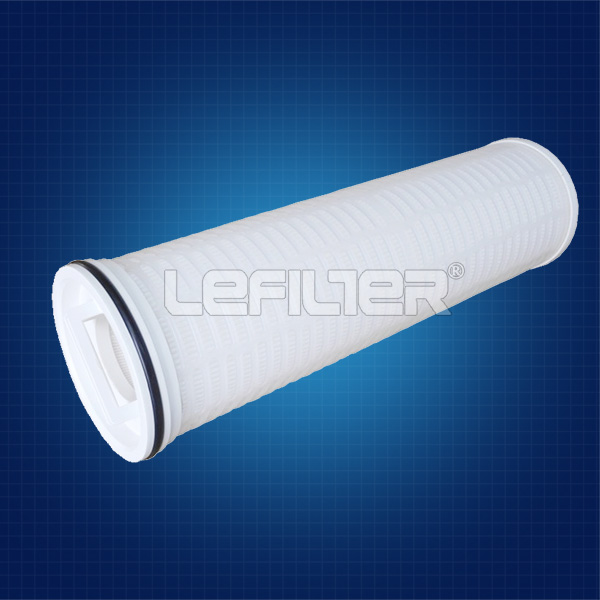
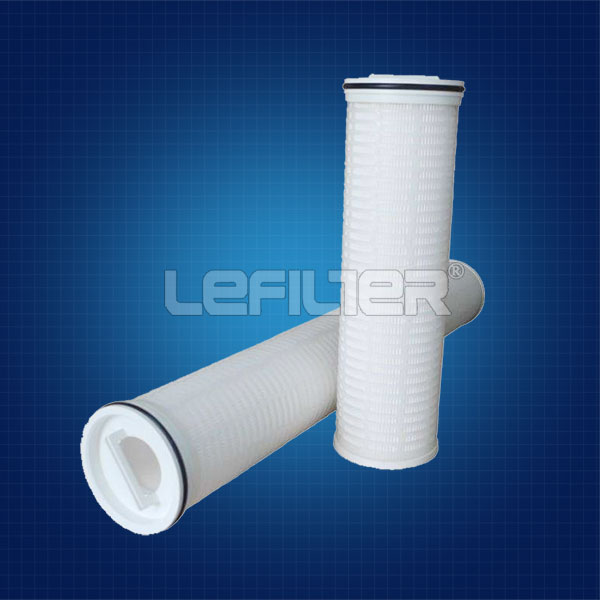
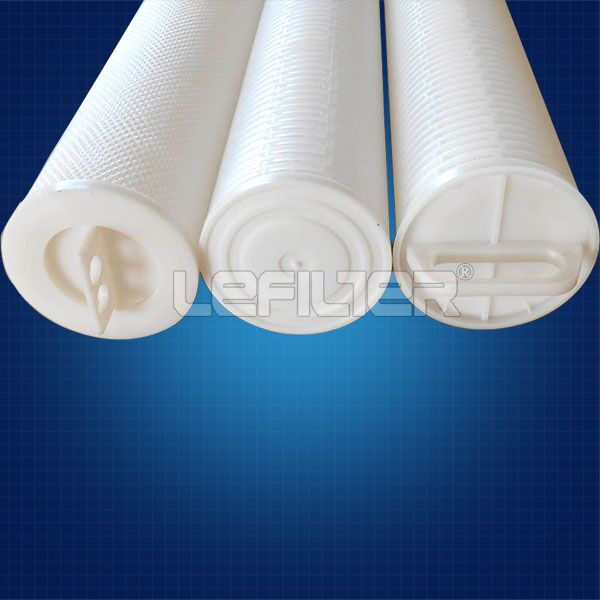
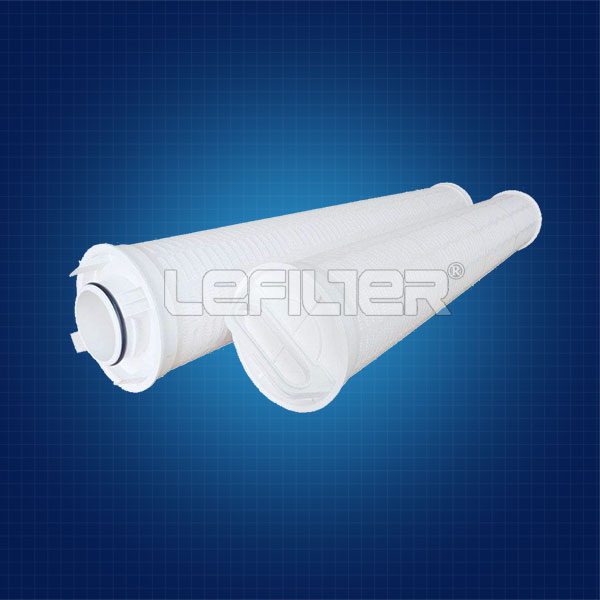
This high flow filter cartridge is a large-format pleated element, six inches in diameter and forty inches long, with a single open end sealing onto the housing plate and a blind opposite end that closes the flow path. In guard duty the value is not capacity but certainty: a large element with a defined absolute rating gives the pump and the membrane a hard particle ceiling, and its area means the differential pressure stays low enough to be monitored rather than discovered. It seats in a water filter housing placed directly upstream of the high-pressure pump, and where the plant draws from an open or stored source rather than a closed treated loop, a self-cleaning filter ahead of the guard stage protects the element from the coarse debris that would otherwise end its life in a single event.
Working Principle
Water enters the housing and flows from the outer surface of the element inward; the pleated medium retains the particles, and only clean filtrate reaches the central core and the outlet. Two behaviours matter here. First, retention happens at the surface, not inside the depth: in guard duty the solids load is low but the particles are fine and hard, so a pleated medium builds a thin cake quickly and then holds it, which is why differential pressure climbs early and then stabilises. Second, the blind end is a safety feature: because one end is closed, all flow must pass the medium, so a correctly seated element cannot bypass — while a partially seated one bypasses silently and passes solids to the membrane while looking perfectly clean. Third, absolute rating defines the ceiling: at 5 μm absolute the element stops the particles that damage a membrane, and the rating is the only number in the specification that has a direct bearing on membrane life.

Typical Specifications
| Parameter | High Flow Pleated Element |
|---|---|
| Format | 6.0 in × 40 in, single open end |
| Media | Pleated polypropylene, graded depth |
| Rating | 5 μm absolute (1–20 μm available) |
| Flow per element | 150–350 gpm (34–80 m³/h) |
| Filtration direction | Outside to inside, blind end cap |
| Maximum differential pressure | 50 psi (0.34 MPa) |
| Recommended change-out differential | 15–20 psi (0.10–0.14 MPa) |
| Maximum operating temperature | 60 °C |
| Collapse pressure | 75 psi (0.52 MPa) |
| Housing | Vertical, one to four elements |
| Seal | O-ring, single open end |
| Upstream requirement | SDI < 5 after pretreatment |
| Typical service life | 3–12 months |
The change-out differential is deliberately conservative: in guard duty the element is cheap relative to the membrane, so the interval should be set to protect, not to maximise element utilisation.
Core Advantages
Defined absolute ceiling. A measurable particle limit ahead of the high-pressure pump.
Low differential pressure. Wide area keeps the guard stage from becoming a flow restriction.
Blind end cap. No bypass path when correctly seated.
Compact housing. Fits into an existing pretreatment skid without new civil work.
Fast, clean change-out. One person, no element stack, minimal downtime.
Application Scenarios
Typical installations serve RO and NF membrane guard filtration, ultrafiltration permeate polishing, carbon filter outlet protection, boiler and cooling make-up RO trains, and any membrane system where upstream treatment is good but not perfect.

Competitive Position and Replacement Notes
This element is an independent compatible replacement for the mainstream large-format high-flow envelopes. Brand names and model designations referenced in this article are trademarks of their respective owners and are used only to describe dimensional, flow, pressure and duty compatibility. There is no affiliation, endorsement or original-equipment supply relationship, and LEFILTER does not supply original-brand elements.
A guard filter protects the membrane; it does not treat the water. Where SDI is out of specification upstream, a finer cartridge only converts a pretreatment problem into a cartridge replacement schedule.
Selection Guide
Confirm the particle ceiling the membrane warranty or OEM guidance requires, then set the absolute rating.
Size element count from design flow, allowing one spare position per housing.
Verify housing plate, seal and element length before ordering.
Check the pressure available at the guard outlet, since a dirty element adds resistance ahead of the pump.
Install a differential pressure indicator with a local gauge and a transmitter.
Set the change-out alarm below the recommended differential, not at collapse.
Installation and Maintenance Notes
Flush the element to drain before it goes on line, then record differential pressure at design flow as the baseline. Check the blind end seating by feel and by flow, not by appearance. Trend differential pressure weekly; in guard duty a sudden rise usually means an upstream upset rather than gradual fouling, so investigate the source before changing the element. Replace the O-ring at every change, keep the interior of the housing clean during change-out, and log each replacement with SDI, turbidity and differential pressure so the interval reflects the plant rather than a table.
FAQ
Q1. What rating is usual for RO guard filtration?
A1: Typically 5 μm absolute; 1 μm is used where the membrane guidance is stricter, at higher differential pressure.
Q2. Can the guard filter replace ultrafiltration?
A2: No. It removes residual particles; it cannot deliver a stable SDI on a variable feed.
Q3. What happens if an element collapses?
A3: Solids pass directly to the membrane; the resulting damage is usually permanent and shows as a step change in differential pressure.
Q4. How do I know the element is seated correctly?
A4: By flow and differential pressure at commissioning, and by confirming the blind end is fully engaged before closing the housing.
Q5. Does this element replace an original-brand part?
A5: It is an independent compatible replacement matched by envelope and duty class; brand names describe compatibility only.
Related Products
RTM61HF200E 60 Inch High Flow Filter Cartridge
HFU660UY200H13 Replacement High Flow Filter Cartridge
Pentair Aqualine ALN01‑60B Large‑Diameter High‑Flow Pleated Filter Cartridge
3M 5613503 HF90 Quick‑Connect 0.2μm High‑Flow Water Filter Cartridge
Please fill in your procurement needs and contact information