High Flow Filter Cartridge for Cooling Tower Side-Stream Filtration
Introduction:Cooling tower water does not need to be clean; it needs to stay within a band. Suspended solids, airborne dust, corrosion products and biological slime accumulate in the basin and then travel to every heat exchanger on the loop, where they settle in low-velocity zones and start under-deposit corrosion. Side-stream filtration takes a small fraction of the circulating flow, filters it and returns it to the basin — a slow, continuous dilution of the dirt that never stops arriving. The filter that does this job has to be cheap to run, large in dirt-holding capacity and small in footprint, because the space beside a tower basin is usually the worst space on site. This article covers a high-flow filter cartridge for cooling tower side-stream duty, including construction, working principle, typical specifications, advantages in circulating water service, application scenarios, compatibility notes, selection criteria and the differential pressure control that keeps a side-stream skid worth running.
We're here to help:
Easy ways to get the answers you need.
Product parameter:
Product Introduction
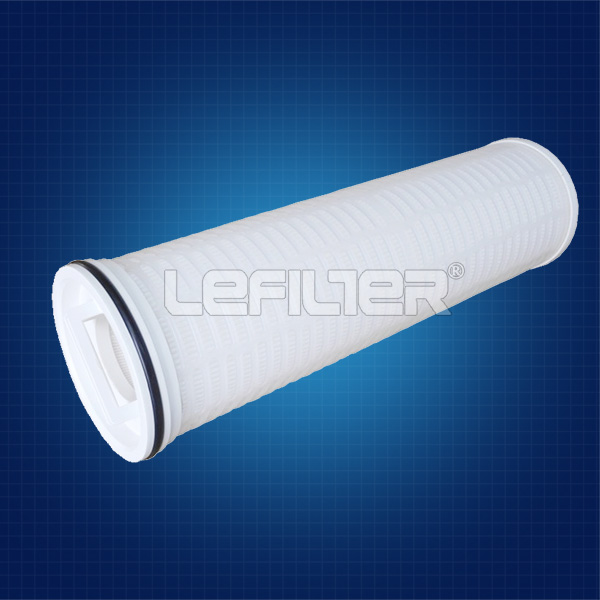
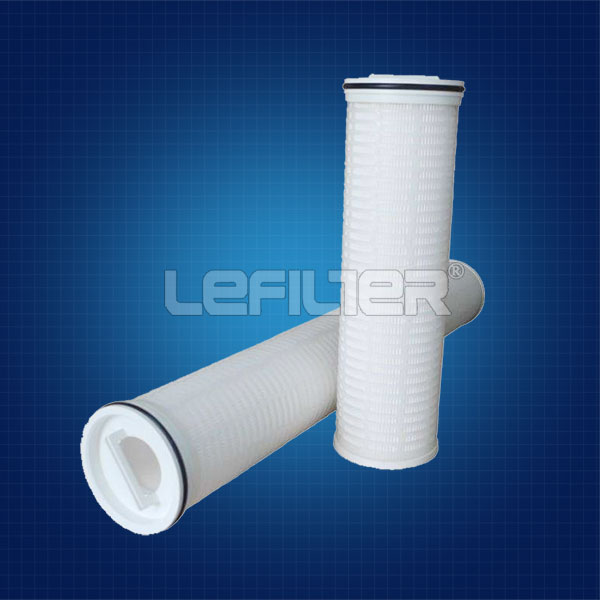
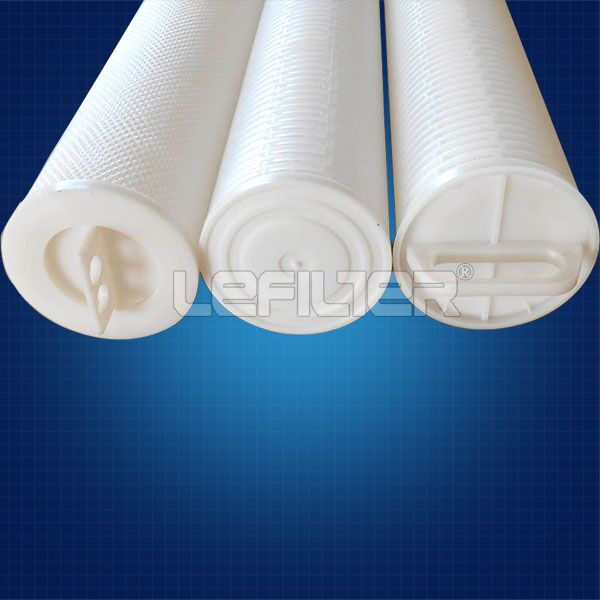
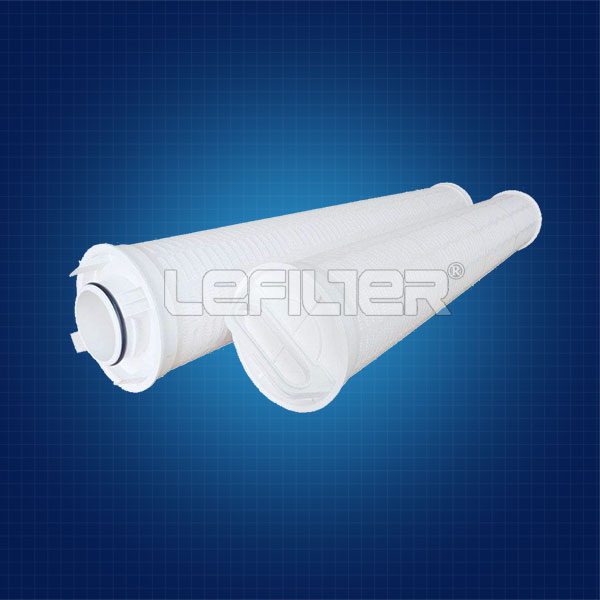
This high flow filter cartridge is a large-format pleated element, six inches across and forty inches long, with a single open end that seals onto the housing plate; the blind opposite end forces the whole side-stream flow through the medium. Its value in this duty is area: one element holds the media of five to seven conventional cartridges, so a two-element skid handles the side-stream flow that would otherwise need a rack of small housings and a service platform. It seats in a water filter housing sized for the large format and installed beside the basin, and where the tower draws from an open, dusty source or a basin with visible debris, a self-cleaning filter on the suction side keeps the coarse material out of the cartridge and extends the interval accordingly.
Working Principle
Side-stream water is drawn from the basin, pumped through the housing, filtered from outside to inside and returned to the basin or to the tower distribution header. Three interactions matter. First, side-stream filtration is a mass balance, not a polish: the skid removes a fixed mass of solids per hour, so the basin concentration falls only as long as the removal rate beats the ingress rate — dust, make-up water and corrosion all keep feeding the loop. Second, the right rating is coarse: at 5 to 25 μm absolute the element captures the particles that settle in heat exchangers, while a finer rating buys nothing and costs differential pressure. Third, the flow fraction decides the result: side-stream skids are usually sized at 1 to 5% of circulating flow, and the choice between them is a decision about how fast the basin should clean up, not about the filter itself.

Typical Specifications
| Parameter | High Flow Pleated Element |
|---|---|
| Format | 6.0 in × 40 in, single open end |
| Media | Pleated polypropylene |
| Rating options | 5, 10, 20 or 25 μm |
| Flow per element | 150–350 gpm (34–80 m³/h) |
| Side-stream fraction | 1–5% of circulating flow |
| Maximum differential pressure | 50 psi (0.34 MPa) |
| Recommended change-out differential | 20–25 psi (0.14–0.17 MPa) |
| Maximum operating temperature | 60 °C |
| Collapse pressure | 75 psi (0.52 MPa) |
| Housing | Vertical, one or two elements per skid |
| Seal | O-ring, single open end |
| Filtration direction | Outside to inside |
| Typical service life | 2–6 months (dust and load dependent) |
The change-out differential is lower than in condensate duty on purpose: in side-stream service the element is expected to be replaced often and cheaply, not driven to its limit.
Core Advantages
Large dirt-holding capacity. Holds the mixed dust, scale and biological debris of an open loop.
Small footprint beside the basin. Two elements replace a rack of conventional cartridges.
High flow per element. Matches a side-stream pump without a long housing train.
Coarse ratings without penalty. 10–25 μm elements keep differential pressure low.
Simple service. A one-person change-out that does not need the loop to be drained.
Application Scenarios
Typical installations serve HVAC cooling towers on commercial and institutional sites, industrial process cooling towers, power plant cooling water, data centre evaporative systems, and any open recirculating loop where basin solids have become a maintenance problem.

Competitive Position and Replacement Notes
This element is an independent compatible replacement for the mainstream large-format high-flow envelopes. Brand names and model designations referenced in this article are trademarks of their respective owners and are used only to describe dimensional, flow, pressure and duty compatibility. There is no affiliation, endorsement or original-equipment supply relationship, and LEFILTER does not supply original-brand elements.
Side-stream filtration complements water treatment; it does not replace blowdown, biocide dosing or corrosion control. A skid that is asked to substitute for a chemistry programme will run at a differential pressure it cannot sustain.
Selection Guide
Measure basin suspended solids and the ingress rate before choosing the side-stream fraction.
Select 1–3% of circulating flow for routine control, 3–5% for a basin with a known solids problem.
Choose 10–25 μm absolute; finer ratings only raise differential pressure.
Confirm the housing plate, seal and element length, then verify pump head at the design flow.
Provide a drain and a flush connection at the skid, since basin debris arrives in bursts.
Set change-out on differential pressure and keep one spare element per housing.
Installation and Maintenance Notes
Commission with the differential pressure recorded at design flow and again after a week, because a new element wets out and settles. Trend differential pressure monthly; in an open loop the interval can halve after a dusty season or a fill of poor make-up water. Isolate, drain and vent the housing before opening, replace the O-ring at every change and confirm the blind end seats fully. Check the suction screen and self-cleaning filter after storms, and log each change with basin turbidity, differential pressure and runtime so the interval can be matched to the site rather than to a generic table.
FAQ
Q1. Does side-stream filtration replace blowdown?
A1: No. It removes suspended solids; blowdown controls dissolved solids and cycles of concentration. Both are needed.
Q2. What side-stream flow fraction is normal?
A2: Typically 1–5% of circulating flow, chosen from the basin solids load and the clean-up rate wanted.
Q3. What rating should I use for tower water?
A3: Usually 10–25 μm absolute; finer ratings add differential pressure without a benefit in this duty.
Q4. Can I install the skid without draining the tower?
A4: Yes, with isolation valves and a drain on the housing; only the skid volume is lost.
Q5. Does this element replace an original-brand part?
A5: It is an independent compatible replacement matched by envelope and duty class; brand names describe compatibility only.
Related Products
RTM61HF200E 60 Inch High Flow Filter Cartridge
HFU660UY200H13 Replacement High Flow Filter Cartridge
Pentair Aqualine ALN01‑60B Large‑Diameter High‑Flow Pleated Filter Cartridge
3M 5613503 HF90 Quick‑Connect 0.2μm High‑Flow Water Filter Cartridge
Please fill in your procurement needs and contact information