High Flow Filter Cartridge for Power Plant Condensate Polishing
Introduction:Condensate polishing does not fail loudly. A condensate system loses performance through a slow chain: iron corrosion products from the feed train, resin fines carried over from a mixed bed, and a growing differential pressure across a filter that nobody has looked at since commissioning. The filter in front of that chain decides how much of it reaches the boiler. A large-format cartridge changes the economics of that filter entirely — one element replaces five to seven conventional cartridges, so the same housing holds far more media in a far smaller footprint, and a change-out becomes a one-person job instead of a crew task. This article covers a high-flow filter cartridge for power plant condensate polishing, including construction, working principle, typical specifications, advantages in condensate duty, application scenarios, compatibility notes, selection criteria and the differential pressure discipline that keeps a polishing loop clean.
We're here to help:
Easy ways to get the answers you need.
Product parameter:
Product Introduction
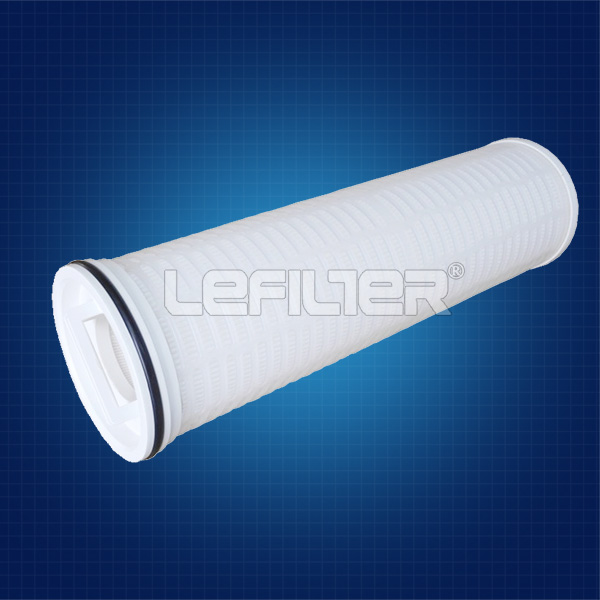
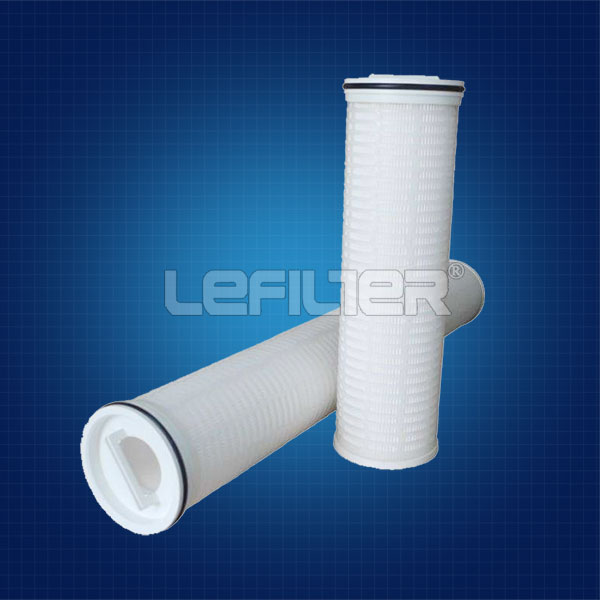
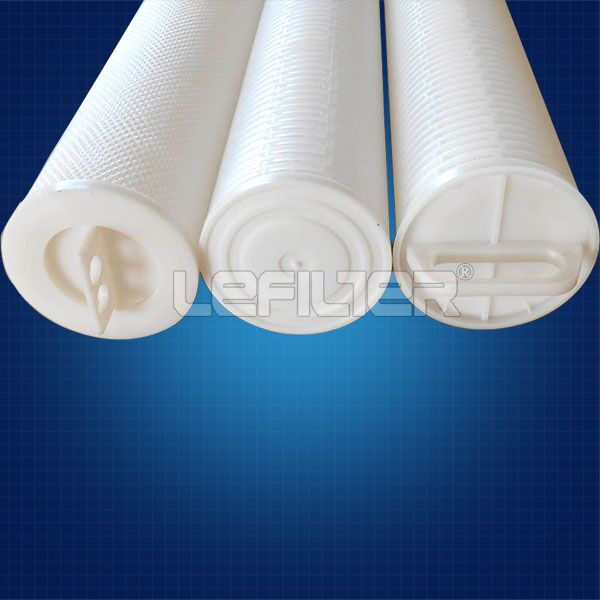
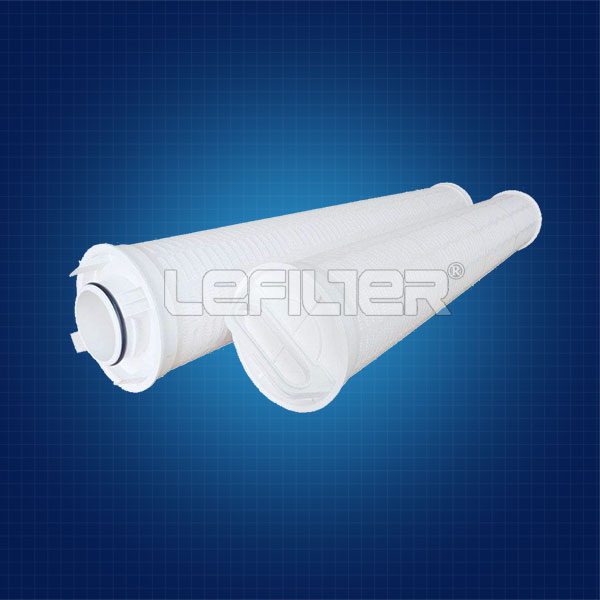
This high flow filter cartridge is a large-format pleated element, six inches in diameter and forty inches long, with a single open end that seals into the housing plate and a blind opposite end that forces all flow through the media. One element carries the media area of five to seven conventional two-and-a-half-inch cartridges, which means a shorter housing, fewer seals, and a change-out that does not need a tool box and three people. It seats in a standard water filter housing sized for the large-format element, and where the polishing loop draws from a stored or open source rather than a closed condensate cycle, a self-cleaning filter upstream removes the coarse debris that would otherwise shorten the cartridge interval by an order of magnitude.
Working Principle
Condensate is pumped into the housing, passes through the pleated media from outside to inside, and leaves through the single open end; the blind end cap forces the whole flow through the medium rather than allowing a short path. Three mechanisms matter in this duty. First, surface loading precedes depth loading: condensate solids are mostly fine iron oxide and resin fines, so the element builds a cake on the pleats rather than penetrating them, and differential pressure rises in a predictable curve. Second, absolute rating is a boiler protection decision: a nominal rating lets a fraction of the particles through, which at condensate flow rates means a measurable annual mass reaching the mixed bed and the boiler. Third, flow per element sets the array size: the large-format element runs at a much higher flow than a conventional cartridge, so the housing count and the piping layout shrink accordingly.

Typical Specifications
| Parameter | High Flow Pleated Element |
|---|---|
| Format | 6.0 in × 40 in, single open end |
| Media | Pleated polypropylene or glass-fibre composite |
| Absolute rating | 1, 3 or 5 μm |
| Flow per element | 150–350 gpm (34–80 m³/h) |
| Equivalent conventional cartridges | 5–7 × 2.5 in × 40 in |
| Maximum differential pressure | 50 psi (0.34 MPa) |
| Recommended change-out differential | 25–30 psi (0.17–0.21 MPa) |
| Maximum operating temperature | 80 °C |
| Collapse pressure | 75 psi (0.52 MPa) |
| Housing | Vertical, single- or multi-element |
| Seal | O-ring, single open end |
| Filtration direction | Outside to inside |
| Typical service life | 3–12 months (duty dependent) |
The differential pressure figures are the practical ones: the element holds far more solids than a conventional cartridge, so the change-out is set by pressure, not by a calendar.
Core Advantages
Large media area in a small housing. Cuts footprint and piping on a congested condensate skid.
High flow per element. Fewer cartridges, fewer seals, fewer leak paths.
Absolute rating. Gives a defined particle ceiling ahead of the mixed bed.
Long service interval. High dirt-holding capacity reduces change-out frequency and labour.
Simple single-person change-out. No special tools, no element stack to reassemble.
Application Scenarios
Typical installations serve condensate polishing pre-filters, boiler feedwater and make-up filtration, turbine lube-oil cooler water, closed cooling water loops, and utility water filtration where conventional cartridge counts have become impractical.

Competitive Position and Replacement Notes
This element is an independent compatible replacement for the mainstream large-format high-flow envelopes. Brand names and model designations referenced in this article are trademarks of their respective owners and are used only to describe dimensional, flow, pressure and duty compatibility. There is no affiliation, endorsement or original-equipment supply relationship, and LEFILTER does not supply original-brand elements.
A high-flow element is not interchangeable with a conventional cartridge set on a one-for-one basis. The housing, the seal arrangement, the flow per element and the differential pressure allowance all change together, so the retrofit has to be checked as a system rather than as a part substitution.
Selection Guide
Define the particle ceiling the boiler and mixed bed can tolerate, then choose the absolute rating.
Size the element count from actual condensate flow, not from the old cartridge count.
Confirm the housing plate, seal type and element length before ordering.
Verify the maximum differential pressure and collapse rating against the pump curve.
Check the media and binder for the operating temperature at the filter inlet.
Set the change-out on differential pressure, and keep one spare element per housing on site.
Installation and Maintenance Notes
Commission with the differential pressure recorded at design flow, and re-check it after the first week, since initial seating and media wet-out settle the reading. Trend differential pressure rather than absolute value, and change elements at 25–30 psi rather than at the collapse limit. Drain and vent the housing before opening, replace the O-ring at every change, and confirm the blind end is fully seated — a partially seated element bypasses and passes solids while looking clean. Verify the resin trap downstream after any mixed-bed disturbance, and log each change-out with flow, differential pressure and hours so the interval can be optimised.
FAQ
Q1. Why use a high-flow element instead of more conventional cartridges?
A1: Because one element replaces five to seven, which cuts housing size, seal count, and change-out labour at the same flow.
Q2. What absolute rating is usual for condensate polishing?
A2: Typically 1 to 5 μm absolute, set by the particle ceiling the mixed bed and boiler can accept.
Q3. Can I fit a high-flow element into my existing housing?
A3: Only if the housing was built for the large-format element; the plate, seal and length differ from conventional cartridge housings.
Q4. How often should the element be changed?
A4: On differential pressure, usually 25–30 psi; in clean condensate duty that may be six to twelve months.
Q5. Does this element replace an original-brand part?
A5: It is an independent compatible replacement matched by envelope and duty class; brand names describe compatibility only.
Related Products
BW30FR-400/34 Water Treatment RO Reverse Osmosis Membrane
40-inch RO membrane water purifier membrane
High Efficiency Reverse Osmosis Membrane for Water Treatment
Commercial Reverse Osmosis Membrane for Pure Water System
High Salt Rejection RO Membrane for Brackish Water Treatment
Please fill in your procurement needs and contact information