The project belongs to the industrial waste disposal and resource utilization project, with a processing
capacity of 50000 tons per year.
The production equipment uses inorganic acids as decomposition agents and adopts selective diffusion
technology to fully separate useful elements from waste residue. Lithium is used to produce lithium
carbonate, while gas, aluminum, sodium, and magnesium are used to produce high molecular weight
cryolite and magnesium sulfate heptahydrate. High purity carbon powder is recovered, and precipitation
method white carbon black is produced as a by-product.
Require effective control and recycling of waste residue, wastewater, and exhaust gas generated during
the production process, with minimal or standard emissions.
Water source and quality
The raw water is tap water, with a chromaticity<10, turbidity of 0.51, no visible substances, pH value of
7.41, total iron, manganese, copper, and zinc content (mg/L)<0.04, chloride content (mg/L) 37.4, sulfate
content 28.4, total dissolved solids 447, total hardness (calculated as CaCO3) 319, oxygen consumption 0.8,
and volatile phenols 0.002.
Water quality requirements
The system design is based on a one on one backup design, with a maximum water production capacity of
40m ³/h and a minimum water production capacity of 20m ³/h for the first stage RO, and a maximum water
production capacity of 20m ³/h and a minimum water production capacity of 10m ³/h for the second stage RO.
The surplus water from the first stage reverse osmosis is used for boiler makeup water, while the second stage
reverse osmosis is used for production process water.
Solution Overview
The process flow of industrial desalination water treatment system is divided into three parts: pretreatment
system, reverse osmosis system, and post-treatment system.
The raw water is heated by the raw water heater and enters the sand filter. The carbon filter filters, intercepts
and adsorbs impurities such as suspended solids and turbidity colloids to remove them from the water. The
pre treated water enters the first stage reverse osmosis system for desalination treatment. The pure water
flows into the first stage water production tank and is then added to the second stage reverse osmosis for
desalination treatment. The pure water is stored in the second stage water tank; Enter the water process
point through the lifting pump.
The secondary RO concentrated water flows back to the original water tank for recycling, with a reflux rate of
5m ³/h per set, for a total of 2 sets.
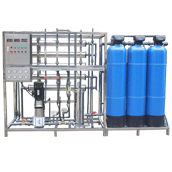
This dual stage reverse osmosis device uses 30 membrane elements per set, packed in 6 5-core pressure vessels.
The first level reverse osmosis arrangement is 2:2, with a designed water production capacity of 20m ³/h.
The arrangement of secondary reverse osmosis is 1:1, with a designed water production capacity of 10m ³/h.
On-site Report


Process Flow
Pressurized raw water → Raw water tank → Raw water pump → Plate heat exchanger → Multimedia filter → Activated carbon filter → Pipeline mixer (dosing reducing agent/scale inhibitor) → First-stage RO security filter → First-stage RO high-pressure pump → First-stage RO reverse osmosis device → First-stage RO product water tank → Second-stage RO booster pump → Pipeline mixer (dosing acid/alkali interstage) → Second-stage RO security filter → Second-stage RO high-pressure pump → Second-stage RO reverse osmosis device → Second-stage RO product water tank (demineralized water tank) → Second-stage demineralized water supply pump → Water consumption point.
First-stage RO concentrated water → Concentrated water collection tank → Pretreatment system flushing → Discharge.
Performance Guarantee
Average water production of multimedia filter: ≥2×40 m³/h (1 unit in operation, 1 unit on standby for continuous operation)
Average water production of activated carbon filter: ≥2×40 m³/h (1 unit in operation, 1 unit on standby for continuous operation)
Water production of first-stage RO reverse osmosis device: ≥2×20 m³/h (1 unit in operation, 1 unit on standby for continuous operation)
Water production of second-stage RO reverse osmosis device: ≥2×10 m³/h (1 unit in operation, 1 unit on standby for continuous operation)
Product Water Quality Indicators