Reverse osmosis equipment safeguards the "ultrapure water password" of microelectronics manufacturing
In the world of semiconductor wafer manufacturing, which is as precise as stars, every micrometer level
process cannot be separated from the gentle care of "ultrapure water". This water, which is tens of millions
of times purer than distilled water, can be called the "blood" of the microelectronics industry, and reverse
osmosis equipment is the core guardian of this "water quality defense line".
The 'water quality revolution' in the micro world: how can reverse osmosis technology overturn tradition?
Imagine a nanoscale 'precision filter' - the micropores of a reverse osmosis membrane are only 0.1-1
nanometers, which is 500 times smaller than a virus. It applies high pressure to allow water molecules to
penetrate the "filter", while pollutants such as dissolved salts, organic matter, and bacteria are precisely
intercepted. This technology, which originated from seawater desalination research, is now creating
miracles in the preparation of microelectronic ultrapure water: removing 95% -99% of dissolved salts,
intercepting more than 99% of particles and microorganisms, and making the water quality reach electricity.
Ultimate purity with a resistivity of 18.2MQ cm (25 ° C). Compared to traditional ion exchange technology,
the reverse osmosis system is like an "intelligent steward": it does not require a large amount of acidic
or alkaline agents, reduces wastewater discharge by more than 30%, and can operate stably for 24 hours,
providing a "very low impurity interference" production environment for key processes such as wafer
cleaning and photolithography etching.

The 'water quality red line' of microelectronics manufacturing: an invisible threshold for trillion level
industries
On a 12 inch wafer production line, even a particle impurity of 0.05um (1/2000 of a human hair) can cause
a short circuit in integrated circuits. 5ppb (equivalent to dropping 1 milliliter of ink into West Lake) of
organic carbon residue can damage the characteristics of photoresist materials. That's why the microelectronics
industry has strict requirements for ultrapure water - it directly determines chip yield and product reliability.
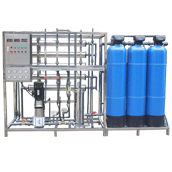
As the "core checkpoint" for ultrapure water preparation, reverse osmosis equipment forms a "core process
combination" with pretreatment, EDI electro deionization, ultraviolet sterilization and other processes. In a
semiconductor factory, its reverse osmosis system helps to improve product yield by 3.2% annually, which is
equivalent to reducing 32000 defects in 1 million wafers, directly converting into tens of millions of yuan in
quality benefits.

From design to operation: creating a "leak proof" purification system
1. Customized pre-treatment plan for "water" quantity
Facing different water sources (tap water, groundwater, or surface water), reverse osmosis systems require
"exclusive protective clothing": groundwater needs to first remove calcium and magnesium ions to prevent
scaling, surface water needs to intercept colloids through ultrafiltration, and municipal water needs activated
carbon to adsorb residual chlorine. In a renovation case of a certain display panel factory, the problem of
water quality fluctuation was completely solved through the combination process of "UF ultrafiltration+RO
reverse osmosis+EDI", and the discharge of acid and alkali wastewater was reduced by 5000 tons per year.
2. Intelligent operation and maintenance to solve the problem of "membrane fouling"
The service life of membrane components is crucial for operation and maintenance. By installing online
conductivity meters and pressure sensors for real-time monitoring, combined with anti fouling membrane
materials and periodic chemical cleaning, a semiconductor factory has extended the lifespan of RO
membranes from 2 years to 4 years, reducing operating costs by 40%. Intelligent systems can also achieve
remote warning, making "running with illness" a thing of the past.
3. The "energy-saving password" for green manufacturing
The energy recovery device is like a "pacemaker" in the system, reducing the energy consumption of the
high-pressure pump by 30%; Designed with a recovery rate of 70% -85%, allowing every drop of water to
be fully utilized. In today's increasingly precious water resources, this "low consumption and high efficiency"
technology route is becoming a standard for semiconductor factories to undergo green transformation.
The future is here: the three major evolutionary directions of reverse osmosis technology
As the chip manufacturing process enters the "quantum field" below 3nm, the standard for ultrapure
water is also continuously upgrading. In the future, there will be three major breakthroughs in reverse
osmosis technology:
Material Revolution: Nanocomposite membranes enable desalination rates to exceed 99.9%, while also
possessing stronger anti pollution capabilities;
Smart upgrade: AI algorithms optimize operating parameters in real-time, achieving "predictive
maintenance" and eliminating faults at the early stages;
Circular economy: Concentrated water recovery technology overcomes the last 15% of the "wastewater"
problem, helping semiconductor factories move towards "zero water consumption" production.