In the field of industrial production, efficient purification and rational utilization of water resources are
important links to ensure stable production operation. A gasification company in Ningxia has completed
the construction and commissioning of a 40t/h × 2 reverse osmosis desalination plant. Through
systematic design, standardized construction, and rigorous commissioning, this project provides a
practical case for industrial water treatment.
Focusing on the technical requirements of water purification

In industrial production, there are strict requirements for the stability and purity of water quality. This
project is based on the actual demand for desalinated water in the company's production, aiming to
achieve deep purification of raw water through reverse osmosis technology and provide standard water
for the production system. The project covers the entire process design, equipment supply, on-site
installation, and commissioning from raw water pretreatment to desalinated water production, following
relevant national and industry standards throughout the process to ensure system stability and reliability.

The environmental conditions of the project location have certain peculiarities: the extreme temperature
range is from -28.0 ℃ to 37.9 ℃, the altitude is 1100 meters, the seismic fortification intensity is 8 degrees,
and the geological soil layers are mainly composed of silt, silt, fine sand, etc. These natural conditions pose
targeted requirements for system design, requiring full adaptation to the local environment in terms of
equipment selection, structural protection, and other aspects.
Building a comprehensive purification system throughout the entire process

01 Core process design
The system is based on the core framework of "pretreatment+reverse osmosis", forming a closed-loop
water treatment process:
The raw water first enters the raw water tank, and after being pressurized by the raw water pump, it is sent
to a multi-media filter to remove suspended solids, colloids, and other impurities through filter materials
such as quartz sand and anthracite; Subsequently, it enters the security filter to further intercept small
particles, ensuring the safety of subsequent equipment; The treated water is pressurized by a high-pressure
pump and enters the reverse osmosis system, where the selective permeability of the reverse osmosis
membrane is utilized to remove salts, organic compounds, and other components from the water; The
final produced desalinated water is stored in the desalinated water tank and transported to the production
water point through a booster pump.
In order to improve the utilization rate of water resources, the system sets up a concentrated water recovery
section, which introduces the concentrated water generated by reverse osmosis into the concentrated water
tank and partially uses it for filter backwashing, achieving the recycling of water resources.

Key equipment and system configuration
Preprocessing system: equipped with 2 multi-media filters (one in use and one as backup), the tank
body is treated with carbon steel lined rubber for anti-corrosion, and is equipped with pneumatic butterfly
valves for automatic control. It can start backwashing through time setting to ensure stable filtration efficiency.
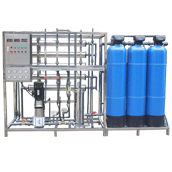
Reverse osmosis system: Each system is equipped with 48 reverse osmosis membranes, using an 8-inch
6-core membrane shell and a high-pressure pump to prevent membrane components from being
subjected to instantaneous high-pressure impact; Simultaneously set up a chemical cleaning
system to regularly maintain the membrane components and ensure their long-term performance.
Automation control: Adopting PLC control system to achieve equipment operation status monitoring,
parameter adjustment, and interlocking protection.
Monitoring instruments: equipped with online monitoring devices such as conductivity meters,
pH meters, temperature meters, etc., to track the water quality indicators of raw water, intermediate water,
and produced water in real time, ensuring stable effluent water quality.

Detail control ensures reliable operation of the system
01 Implementation of Design Principles
The project design follows the principles of "safety and applicability, advanced technology, and economic
rationality":
In equipment selection, priority should be given to selecting materials that are suitable for the local
environment;
In terms of process design, ensure the continuous operation of the system through a "one in use,
one backup" configuration;
In terms of energy conservation, technologies such as concentrated water recovery and variable
frequency control are used to reduce energy and water resource consumption.
02 Equal emphasis on safety and environmental protection
During the project implementation process, implement health, safety, and environmental management
requirements:
The construction area follows civilized construction standards, classifies and treats waste, and reduces
the impact on the surrounding environment;
The equipment installation meets the seismic fortification standards, and key parts are reinforced to
meet the seismic requirements of 8 degrees;
Develop comprehensive safety operating procedures and provide specialized training for construction
and operation personnel to ensure operational safety.
03 Full cycle quality control
The system has established a full process quality assurance system from design to acceptance:
During the design phase, refer to standards such as the "Design Specification for Industrial Water
Softening and Desalination" and "Reverse Osmosis Water Treatment Equipment";
During the installation process, special inspections should be conducted on key links such as pipeline
connections and equipment fixation;
During the acceptance stage, the system will be tested continuously for 168 hours to verify that its
performance meets the standards before it is officially delivered.
Provide technical reference for industrial water treatment

The successful operation of the reverse osmosis desalination device demonstrates the systematic practice
of technology integration, environmental adaptation, safety management, and other aspects in the field of
industrial water treatment. It has achieved efficient purification and stable water supply of raw water
through standardized process design, automated operation control, and refined operation and maintenance
management, providing valuable experience for the construction of water treatment systems in similar
industrial companies.
In the context of water resource protection and sustainable industrial development, such technological
practices provide a practical and feasible path for promoting industrial water recycling and reducing
environmental impact, demonstrating the application value of technological innovation in the industrial field.