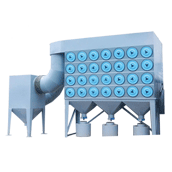


PPC Series Air Box Pulse Baghouse Dust Collector for Cement Industry
Introduction:Heavy-duty industrial processes such as cement grinding, kiln exhaust and powder packaging generate massive dust-laden flue gas with extremely high inlet dust concentration. Ordinary pulse dust collectors often suffer unstable cleaning and short filter bag service life under such harsh working conditions. The PPC air box pulse baghouse dust collector adopts compartment offline cleaning technology, combining the advantages of compartment reverse air cleaning and pulse jet cleaning. It is equipped with high-performance Dust Collector Filter bags and needs a matched Air compressor filter to guarantee clean pulse air source. It can handle high dust concentration flue gas from O-Sepa separators and vertical roller mills, delivering stable outlet dust emission below 50mg/Nm³, widely adopted in cement plants, mineral processing and building material production lines.
We're here to help:
Easy ways to get the answers you need.
Product parameter:
Product Introduction
The PPC series air box pulse baghouse dust collector is a high-efficiency compartment offline pulse bag dust removal equipment. It overcomes the weaknesses of traditional compartment reverse air cleaning (insufficient cleaning kinetic energy) and simultaneous filtration pulse jet cleaning, greatly expanding its working adaptability, improving dust collection efficiency and extending the service life of the Dust Collector Filter. It is suitable for dust collection on crushers, dryers, coal mills, raw material mills, cement mills, packaging machines and silo tops. It can also serve as process dust collection equipment for vertical roller mills and O-Sepa classifiers with very high inlet dust load, and consistently control the outlet dust concentration below 50mg/Nm³.
The standard filter medium is polyester needle felt, with an average service life of more than 2 years and continuous temperature resistance up to 120℃. If Nomex filter material is selected, the maximum temperature resistance can reach 220℃. This design removes venturi tubes and blow pipes on the top of filter bags, which reduces system operating resistance and simplifies inspection and maintenance. The electromagnetic pulse valves are available in 1-1/2 inch and 2-1/2 inch sizes, adopting double diaphragm structure for sensitive control, high efficiency and long service life. To protect the pulse valve diaphragms and prevent oil and water contamination on the Dust Collector Filter, an Air compressor filtermust be installed on the compressed air supply pipeline to remove moisture, oil mist and solid particles from the air source.
Working Principle

The PPC air box pulse baghouse dust collector is divided into multiple independent compartments separated by steel plates. Each compartment is fitted with a lift valve. When dusty flue gas enters the hopper through the air inlet, coarse dust particles settle down by gravity and inertial collision first. The remaining fine dust flows upward into the bag chamber, and the particles are trapped on the outer surface of the Dust Collector Filter bags. Clean gas passes through the filter bag into the upper box, then flows out through the lift valve and air outlet.
As dust accumulates on the outer surface of filter bags, the operating resistance of the dust collector rises gradually. When the resistance reaches the preset range of 1245–1470 Pa, the cleaning controller triggers the cleaning cycle. First, the lift valve of one compartment closes to cut off the flue gas flow of this compartment, so this compartment stops filtering. Then the electromagnetic pulse valve opens instantly, and compressed air at 0.5–0.7 MPa is injected into the box in an extremely short time (0.1–0.15s). The compressed air expands rapidly inside the box and rushes into filter bags, causing violent deformation and vibration of the bags. The dust cake attached to the bag surface falls off into the hopper under the shock and reverse airflow.
After cleaning is completed, the lift valve opens again, and this compartment returns to filtration status. Each compartment is cleaned sequentially one by one. While one compartment is offline for cleaning, other compartments keep filtering continuously, so the whole system runs without shutdown. The cleaning controller supports two control modes: timing control and constant pressure control. Timing control runs according to preset time intervals, suitable for stable working conditions. Constant pressure control monitors the pressure drop in real time and triggers cleaning automatically when the resistance threshold is reached, which is more suitable for fluctuating dust load.
The cleaned dust collected in the hopper is discharged continuously through spiral conveyors, air slide chutes, rotary discharge valves or flap valves at the bottom.
Main Structural Features
Box Body
The box is fully sealed and divided into several independent compartments by steel partitions. The top is designed with a 1.5° inclined surface to prevent rainwater accumulation for outdoor installation. Manholes are reserved on the top for operators to replace filter bags and bag cages conveniently. Each compartment is equipped with a lift valve to isolate airflow during offline cleaning.
Bag Chamber
Located under the box body, the bag chamber holds filter cages and filter bags and forms the main filtration zone. Separated compartments avoid interference between cleaning compartment and filtering compartment, and also provide space for dust settlement.
Hopper
The hopper is arranged at the bottom of the bag chamber. It not only stores settled dust, but also acts as the main air inlet channel for bottom air intake type. The large internal volume slows down the airflow velocity, realizing pre-separation of coarse dust particles. Conveying equipment such as spiral conveyors and air slide chutes are installed inside the hopper, matched with rotary valves for continuous dust discharge.
Air Inlet & Outlet
Two layout types are available. For the 32 series, the air inlet is cylindrical, welded on the side plate of the hopper, and the air outlet is arranged on the side of the box body. Other models adopt a middle partition structure, separating inlet and outlet airflow. This structure has good pre-dedusting effect and is suitable for flue gas with high inlet dust concentration.
Pulse Cleaning System & Control System
It includes electromagnetic pulse valves, air pipeline, lift cylinders and PLC cleaning controller. The pulse valve adopts double diaphragm structure with sensitive response. The compressed air pipeline must be equipped with an Air compressor filter to remove oil and water, avoiding valve failure and filter bag sticking.
Auxiliary Structure
Supporting columns, ladders, guardrails and maintenance platforms are configured for safe inspection and maintenance.
Core Advantages
Offline Compartment Cleaning, No Interference
Cleaning compartment and filtering compartment work independently. The filtration process will not be affected by pulse blowing, so the cleaning effect is much better than online pulse cleaning. The service life of the Dust Collector Filter is greatly extended.
High Dust Concentration Adaptability
It can handle inlet dust concentration up to 1000~1300 g/Nm³, perfectly matching vertical roller mills and O-Sepa powder separators in cement plants, and keeps outlet dust concentration below 0.1 g/Nm³.
Low Operation Resistance
Venturi tubes and independent blow pipes are canceled. The airflow path is optimized, reducing system resistance and energy consumption for the fan.
Multiple Filter Material Options
Standard polyester needle felt for 120℃ working condition; Nomex high-temperature filter bags for flue gas up to 220℃, meeting different high-temperature flue gas requirements.
Reliable Control Mode
Timing control and constant pressure differential control are optional. Constant pressure mode automatically adjusts the cleaning cycle according to actual dust load, avoiding excessive pulse blowing and reducing compressed air consumption.
Modular & Large Capacity Range
Complete model series including PPC32, PPC64, PPC96, PPC128. The air processing capacity ranges from 5600 m³/h up to 314000 m³/h, covering small, medium and large cement production lines.
Easy Maintenance
Filter bags are replaced from the top manhole, no need to enter the hopper. The maintenance workload is low and the downtime is short.
Technical Specification Table
| Series | Model Range | Air Volume (m³/h) | Total Filter Area (m²) | Bag Quantity | Max Inlet Dust Concentration | Outlet Dust Concentration | Operating Resistance |
|---|---|---|---|---|---|---|---|
| PPC32 | PPC32-3 ~ PPC32-8 | 5600 ~ 31200 | 93 ~ 496 | 96 ~ 512 | <200 g/Nm³ | <0.1 g/Nm³ | 1470~1770 Pa |
| PPC64 | PPC64-4 ~ PPC64-8 | 13390 ~ 31200 | 248 ~ 496 | 256 ~ 512 | <1000 g/Nm³ | <0.1 g/Nm³ | 1470~1770 Pa |
| PPC96 | PPC96-4 ~ PPC96-2×10 | 22300 ~ 121000 | 372 ~ 1868 | 384 ~ 1920 | <1300 g/Nm³ | <0.1 g/Nm³ | 1470~1770 Pa |
| PPC128 | PPC128-8 ~ PPC128-2×14 | 67300 ~ 314000 | 1024 ~ 4361 | 896 ~ 3584 | <1300 g/Nm³ | <0.1 g/Nm³ | 1470~1770 Pa |
General shared parameters:
| Item | Parameter |
|---|---|
| Filtration Velocity | <1.0 m/min |
| Negative Pressure Resistance | 5000 Pa |
| Pulse Air Pressure | 0.5~0.7 MPa |
| Filter Bag Specification | Φ130×2450, polyester needle felt 450g/㎡ |
| Standard Continuous Temp | ≤120℃; Nomex option up to 220℃ |
| Pulse Valve Size | 1-1/2 inch / 2-1/2 inch |
| Control Mode | Timing control / constant pressure differential control |
Application Scenarios

Cement Industry (Core Application)
Raw mill, cement mill, coal mill, vertical roller mill, O-Sepa powder classifier, silo top dust collection, packaging station, dryer and crusher dust removal. This is the most mature application field of PPC air box pulse baghouse.
Building Material Industry
Lime calcination, gypsum powder processing, aggregate crushing, stone powder production line.
Metallurgy Industry
Sintering machine, material screening, furnace feeding and material transfer points with high dust concentration.
Mineral Processing Industry
Non-metallic mineral ultrafine powder grinding, crushing and sorting workshop dust control.
Chemical Industry
Powder material drying, granulation and packaging dust collection.
Selection Guidance
When selecting a PPC air box pulse baghouse dust collector, confirm these key parameters:
Flue gas flow rate and inlet dust concentration: PPC96 and PPC128 are preferred for inlet dust concentration higher than 1000 g/Nm³.
Flue gas temperature: choose polyester needle felt for ≤120℃; Nomex filter bags for 120~220℃ high-temperature flue gas.
Filtration velocity: keep below 1.0 m/min strictly. Too high filtration velocity will cause rapid bag wear and high resistance.
Compressed air supply: calculate air consumption according to the model, and configure an Air compressor filter + refrigerated dryer to guarantee dry and oil-free air for pulse valves.
Discharge device: match spiral conveyor, air slide chute or rotary valve according to dust property and discharge capacity.
We can provide full drawing, foundation drawing, spare parts list and Dust Collector Filter bag replacement scheme for your project bidding and on-site installation.
FAQ
Q1: What is the difference between PPC air box pulse dust collector and ordinary pulse bag dust collector?
A: PPC adopts compartment offline cleaning. One compartment is isolated for cleaning while other compartments keep filtering. Ordinary online pulse cleans bags while filtering, which has weaker cleaning effect and shorter filter bag life. PPC is more suitable for high dust concentration heavy-load conditions.
Q2: Why is the Air compressor filter important for this dust collector?
A: The pulse valve diaphragm is very sensitive to oil, water and impurities. Oil and water in compressed air will stick dust on the Dust Collector Filter, block the pores and cause pulse valve failure. The Air compressor filter removes oil mist and water to ensure stable cleaning performance.
Q3: What is the service life of the filter bags?
A: Standard polyester needle felt bags can run more than 2 years under normal operation. Service life depends on flue gas temperature, dust abrasiveness and cleaning frequency. Nomex high-temperature bags have shorter service life but can withstand higher temperature.
Q4: Can this dust collector work under negative pressure?
A: Yes. The whole equipment is designed for negative pressure working condition, with maximum negative pressure resistance of 5000 Pa, which matches the fan layout on the clean gas side.
Q5: How to choose timing control or constant pressure control?
A: Timing control is for stable dust load with simple controller and low cost. Constant pressure differential control automatically adjusts cleaning cycle according to real-time resistance, which saves compressed air and protects filter bags, suitable for fluctuating dust working conditions.
Related Products
Filter Cartridge Dust Collector lefilter P191526-016-436
P19-1006 Dust Collection Filter Cartridges
P19-1037 lefilter dust collector cartridge filter
Please fill in your procurement needs and contact information